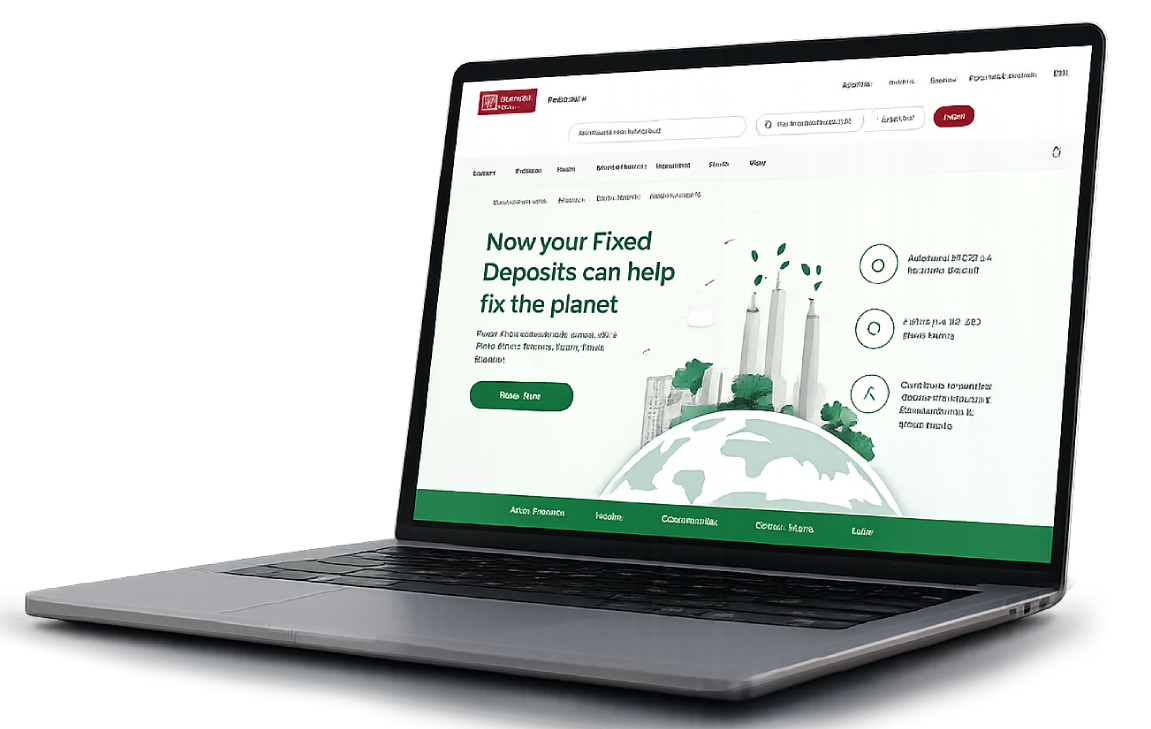
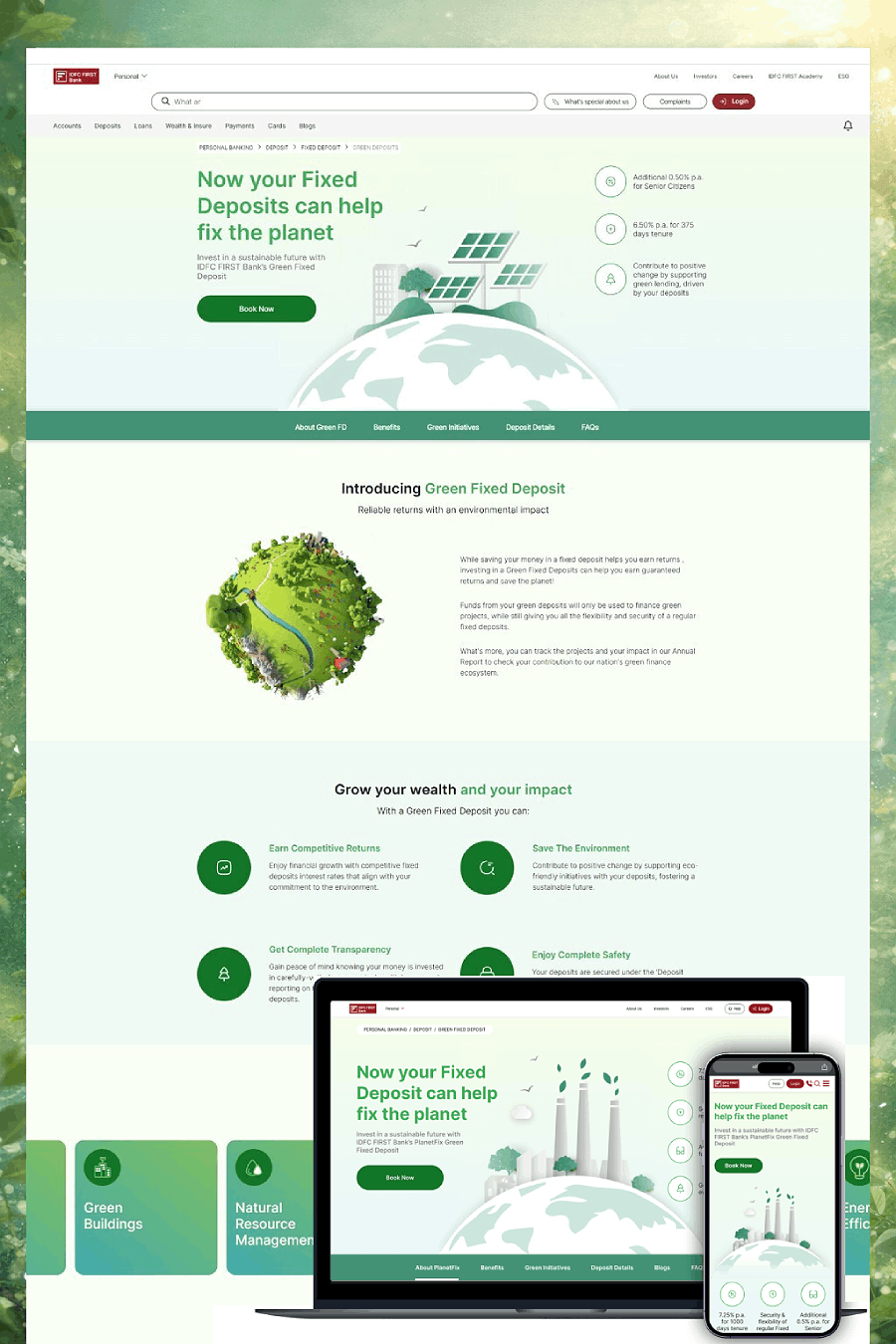
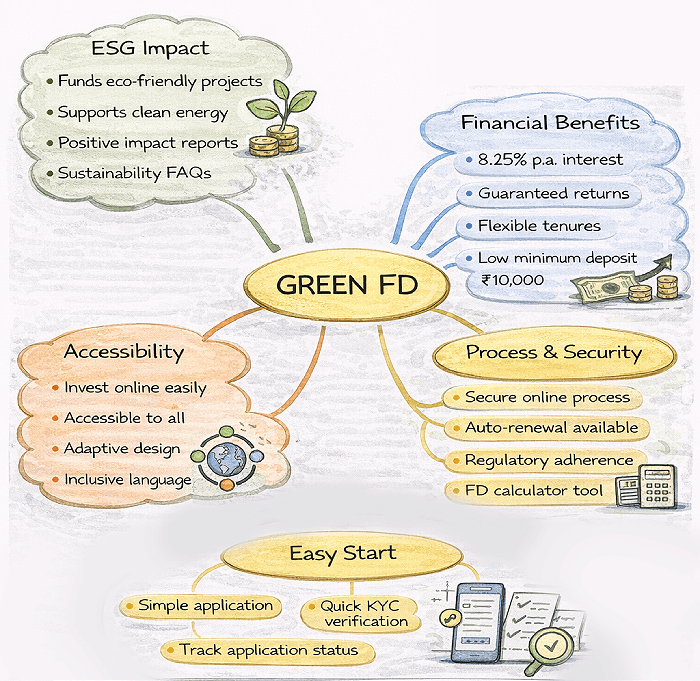
Transforming a regulated, legacy financial product — Green Fixed Deposit — into a modern, accessible, and trust-led digital experience. The objective was not visual modernization alone, but the establishment of a governed product experience system that could scale across channels while meeting regulatory, accessibility, and brand standards.

Comprehension before conversion.
Green FD is a high-trust, long-term product often used by conservative and senior users. The existing experience was disclosure-heavy and optimized for compliance rather than understanding — the mandate was to reverse that.
Research focused on how people interpret financial information and make long-term decisions under uncertainty — emphasizing comprehension, confidence, and accessibility over visual preference.

Methods included review of customer queries and support tickets to identify recurring confusion points, qualitative feedback sessions across conservative and senior user segments, accessibility and readability audits aligned to WCAG, and behavioral analysis of drop-offs and dwell time across the journey.
Findings directly informed content structure, information hierarchy, and interaction decisions — validated through iterative design and measured post-launch with engagement and completion signals.
"I want to understand the return before I think about anything else."
"If I can't read the small print, I'll close it. I won't ask my son."
"Tell me what 'green' actually means here — show me, don't sell me."
Optimizing for disclosure leaves understanding behind.
Dense financial language increased cognitive load and slowed decision-making.
Sustainability value was unclear and abstract — present but not understood.
Users struggled to interpret returns and tenure in their own context.
Accessibility gaps disproportionately affected senior and low-vision users.
I owned the strategic direction, experience vision, and design principles across the program — establishing UX governance, accessibility standards, and decision frameworks aligned to regulatory and business needs.
Guiding principles, aligned with RBI compliance and inspired by government-grade UX systems: clarity before choice; plain language over financial jargon; consistency builds trust; progressive disclosure; and accessibility by default — with readability, contrast, spacing, and focus states as first-class citizens.
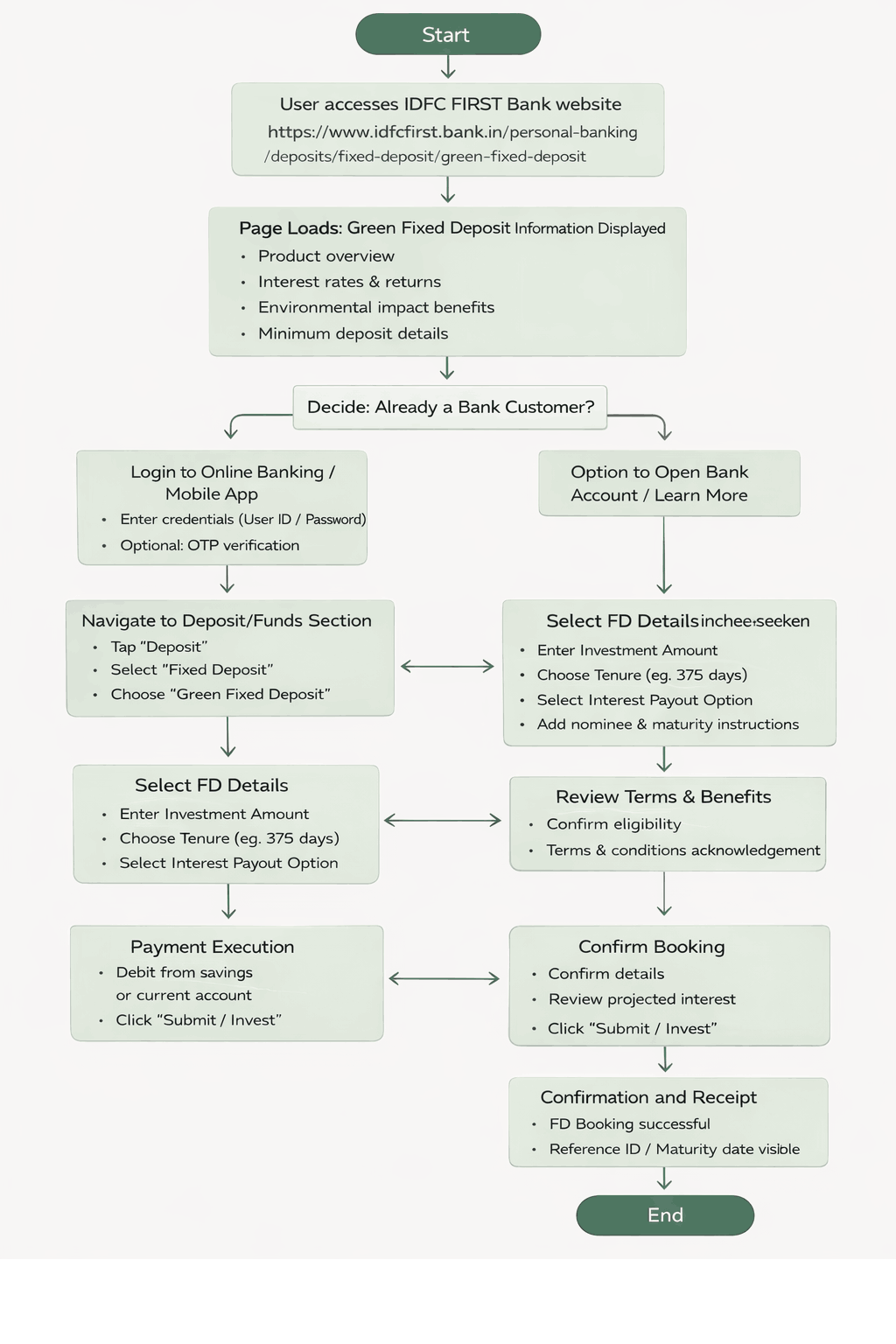
Users were designed to recognize themselves in the journey — conservative or impact-driven investors — before engaging with detailed information. Decision paths were predictable, accessible, and compliant.

Every screen, template, and confirmation message was anchored to a mapped moment. Every sign-off verified that the moment had been designed for, not assumed. The journey map was the canonical reference through every design and vendor review.
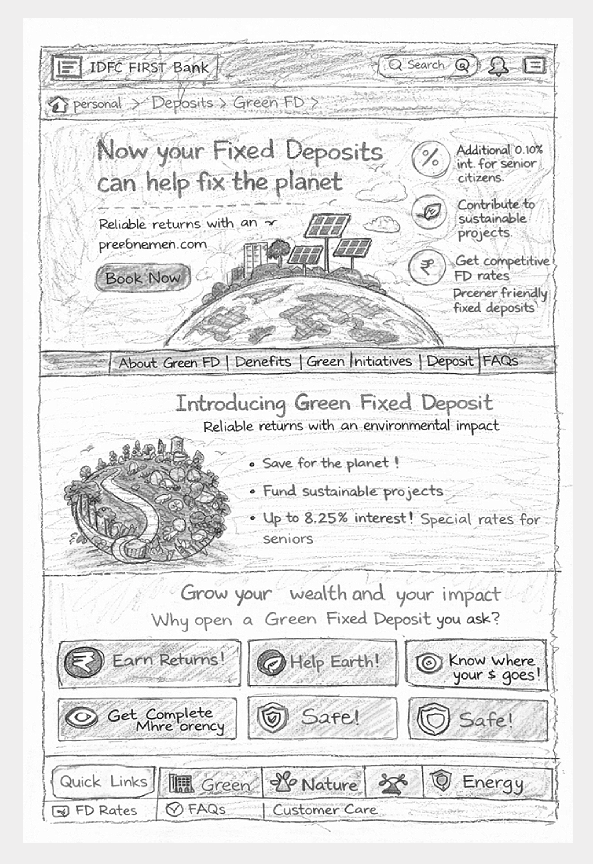
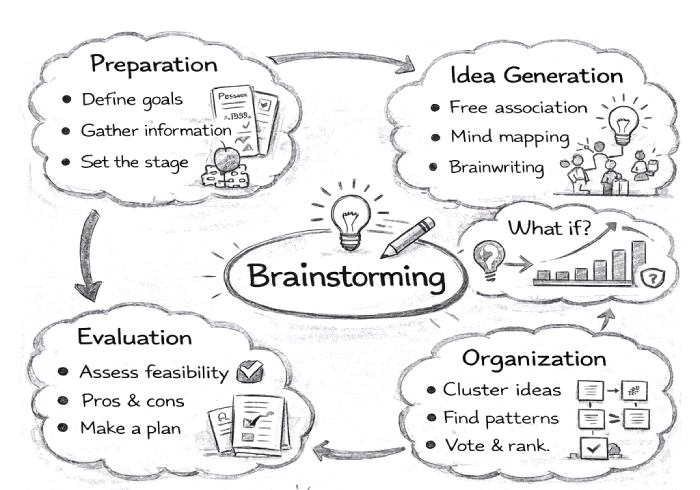
Paper prototyping validated content structure, decision flow, and information hierarchy early — identifying cognitive overload, unclear terminology, and unnecessary steps before visual or technical complexity entered.

Every wireframe was traceable to a journey moment, and every IA decision was signed off before vendor execution. Storyboards were leveraged to align business, brand, talent acquisition, compliance, and vendor teams on what each moment had to feel like — before any pixels were committed.
Eligibility · Approval · Disbursement — a compliant green-finance flow
A reusable set of patterns aligned to bank tokens — accessible typography, high-contrast palettes, and content templates that reduced ambiguity while preserving regulatory disclosure.

Accessibility as governance, not a checklist.
A governance model translated regulatory and accessibility requirements into reusable design patterns and content frameworks — embedding compliance into the experience rather than as a downstream check.
Core UX standards and risk controls were centrally maintained, while implementation remained flexible at the domain level. Governance was lightweight and embedded into delivery workflows, focusing on systemic risks — accessibility, regulatory compliance, brand integrity, apply-flow friction — rather than surface-level design. Continuous improvement was driven through analytics and shared learnings.
Usability testing with 12 participants across conservative, senior, and sustainability-conscious segments evaluated comprehension, decision clarity, and ease of completion across the core Green FD journey.
Role pages restructured so candidates established relevance within seconds. Headline, signal-bearing tags, and growth indicators surfaced before scroll.
Filters and sorting logic refined to align with the criteria candidates actually used — not the criteria the platform exposed by default.
Content hierarchy and CTAs improved so candidates entered the apply flow knowing what to expect. Confirmation messaging validated to reassure on submit.
Insights translated into refinements before launch — reducing rework during vendor implementation and surfacing systemic issues that would have appeared only post-release.
Final designs were validated against UX and accessibility guardrails — delivering a Green FD experience that improved engagement, conversion, and accessibility while preserving regulatory disclosure.

A disclosure-heavy product became a service users could trust — design moved from compliance by paragraph to compliance by pattern.
Green FD shifted from a disclosure-heavy product to a service with a duty of care. Plain language, accessibility, and progressive disclosure were embedded into reusable patterns. Compliance lived inside the design system rather than as a downstream review. UX held the pen on the principles that kept the experience clear and accessible as future iterations shipped.
Designing a regulated, long-term financial product is about restoring understanding, not redecorating disclosures. These are the lessons I'd carry into any high-trust banking product.

When users genuinely understood returns, tenure, and impact, conversion followed without persuasion. The biggest lever was clarity, not creative — comprehension was the funnel.
Conservative investors and senior users defined the accessibility and language baseline. When the experience worked for them, it worked for everyone — and the inverse was never true.
Embedding contrast, typography, spacing, and focus states into reusable patterns meant accessibility shipped by default. Patterns out-perform reviews.
Borrowing principles from public-sector UX — duty of care, plain language, predictable journeys — reframed the work. Green FD was not a marketing surface; it was a service users had to trust over years.