VP, UX Design · Conversational AI · Banking · KORE.ai

Conversation as trusted interface.

Design and rollout of an enterprise-grade Conversational AI service built on KORE.ai for regulated banking and large-scale operations. The challenge was not 'designing a chatbot' — it was defining a new enterprise interaction model where conversation becomes the primary interface for executing complex, high-risk tasks at scale.


🤖
Enterprise
Conversational AI scale
🛡
Auditable
By default
🧭
Consistent
Across domains
🤝
Trusted
Risk-aware design
Personas
Trusted by Leading Brands
BankingKORE.aiRiskComplianceOperationsAgent ops
Scroll
01 — Context

Conversation becomes trusted only when it is governed.

01 — Project overview

A chatbot is a feature.
A service is a system.

Success depended on aligning user experience, AI capability, compliance requirements, and organizational governance into a single coherent service — evaluated on risk, trust, scalability, and long-term operational viability, not just usability.

User personas
User personas
01 — Context

Legacy, fragmented systems

Existing tools were built around internal processes rather than user workflows — forcing agents and operations teams to navigate complex, disconnected tasks.
02 — Constraints

Cognitive overload & siloed AI

Users depended on memory to compensate for inconsistent system behavior, while siloed conversational AI implementations eroded trust by behaving inconsistently across domains.
03 — Opportunity

Conversation as enterprise capability

The opportunity was to scale conversational AI as a trusted, auditable enterprise service — not as an experimental feature.
Business objectives

What the organization needed to achieve

  • Deliver a trusted conversational capability for high-stakes financial use cases
  • Meet strict regulatory and platform constraints across domains
  • Scale conversational AI as an enterprise service, not isolated bots
  • Establish clear governance across UX, AI, compliance, and engineering
  • Operate within the KORE.ai platform's architectural reality
UX & design goals

What the experience needed to do

  • Reduce cognitive load through clear, step-by-step conversational flows
  • Ensure consistent behavior across domains so users can build reliable mental models
  • Embed trust through explicit intent validation, confirmations, and explainability
  • Make auditability and traceability native to the experience
  • Treat error recovery and human handoff as first-class experiences
02 — Research & discovery

In high-stakes finance,
trust beats speed.

Research showed users prioritized trust, control, and clarity over raw speed — driving a design philosophy of structured, step-by-step conversations with deliberate confirmations for critical actions.

Conversational UX research
Conversational UX research insights — trust, control, and clarity prioritized over speed in high-stakes financial workflows
Research & insight — trust, control, and clarity over speed

To support predictability, intents, responses, confirmations, and fallback patterns were standardized across workflows — enabling consistent behavior and reliable mental models. Transparency was built in through clear system signaling and plain-language explanations.

Tolerance for failure was low, so error recovery and human handoff were designed as first-class experiences — reinforcing trust rather than treating them as exceptions.

"If it asks me to confirm twice, I'd rather that than discover a wrong action later."

Operations agent · High-stakes workflow

"When the bot says 'I can't help with that', I need to know what to do next — not be stuck."

Supervisor · Escalation-led

"I trust it once I see it explain why it's recommending something — not just what."

Compliance reviewer · Audit-facing
User personas

Three operational roles.

A
Agents
Real-time · Customer-facing
Execute high-frequency, time-sensitive tasks. Need fast, predictable conversational flows with explicit confirmations on critical actions.
Step-by-stepPredictableExplicit confirm
O
Operations teams
Workflow-heavy · Multi-system
Complete complex, multi-step processes that span systems. Conversation must reduce context switching and surface relevant state at every turn.
StatefulContext-awareLow switching
S
Supervisors & compliance
Oversight · Audit-led
Need explainability, traceability, and clean audit trails. Every system action should be reviewable in plain language.
ExplainableTraceablePlain language
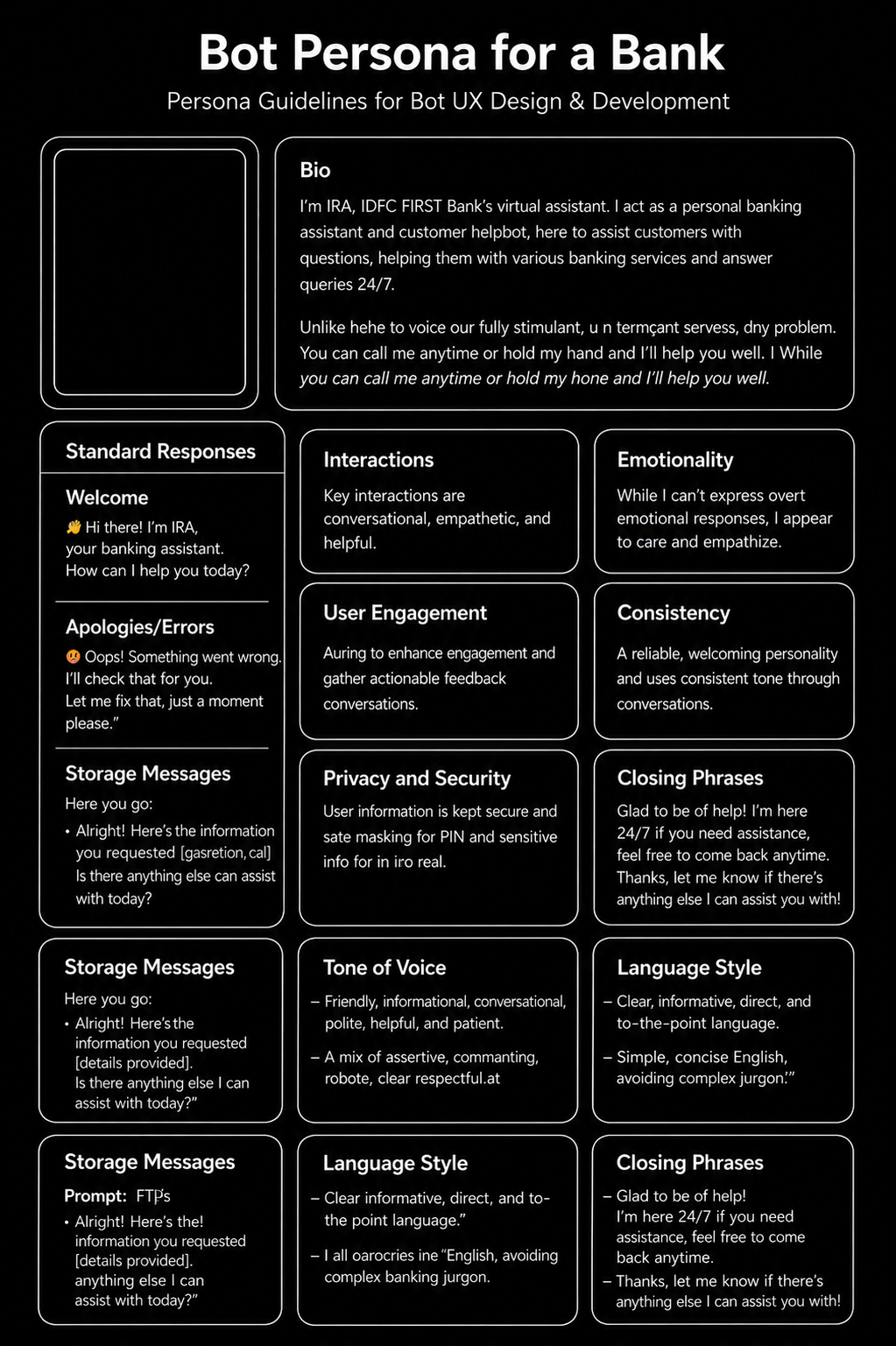
IRA persona cards — operational roles defined by responsibility and risk exposure
Persona cards — roles defined by responsibility, risk, and decision authority
03 — Core problem

Siloed conversational AI erodes trust — consistency is the product.

01

Cognitive overload from legacy systems built around internal processes, not user workflows.

02

Inconsistent behavior across siloed conversational AI implementations eroded trust.

03

Missing confirmations, explainability, and audit trails created regulatory risk.

04

Conversational AI positioned as unreliable support — not a trusted enterprise capability.

04 — My role & execution

A conversational UX framework.
Not a chatbot.

I defined the conversational experience vision and governance framework — acting as the final authority on experience decisions across internal teams and partners.

A Conversational UX Framework was established to standardize how services are designed, governed, and scaled on KORE.ai — treating conversation design as shared enterprise infrastructure rather than isolated chatbot solutions. The framework defined common dialog patterns, turn management, confirmations, error recovery, and escalation; enforced progressive disclosure and explicit validation for regulated workflows; and embedded explainability and audit readiness through transparent system responses and traceable conversation logs.

Responsibility 01

Define conversational strategy

  • Authored the conversational UX strategy and experience direction
  • Defined the new enterprise interaction model for high-stakes tasks
  • Translated AI capabilities into trustworthy interaction patterns
  • Signed-off principles used as the contract for delivery teams
Responsibility 02

Govern internal teams & vendors

  • Ensured alignment with conversational UX standards, accessibility, and compliance
  • Reviewed and approved every milestone before release
  • Embedded guardrails directly into delivery workflows
  • Held final accountability for experience quality
Responsibility 03

Establish intent & decision frameworks

  • Built a unified, function-aligned intent taxonomy
  • Codified dialog patterns, confirmations, fallback, and escalation
  • Reduced ambiguity and duplication across bot use cases
  • Enabled analytics and continuous improvement
Responsibility 04

Enable cross-functional teams

  • Equipped business, product, and engineering with clear processes and guardrails
  • Coached stakeholders on conversational UX trade-offs
  • Established shared vocabulary across UX, AI, and compliance reviews
  • Made governance lightweight and embedded into delivery
05 — User journey map

Greet. Clarify.
Execute. Confirm.

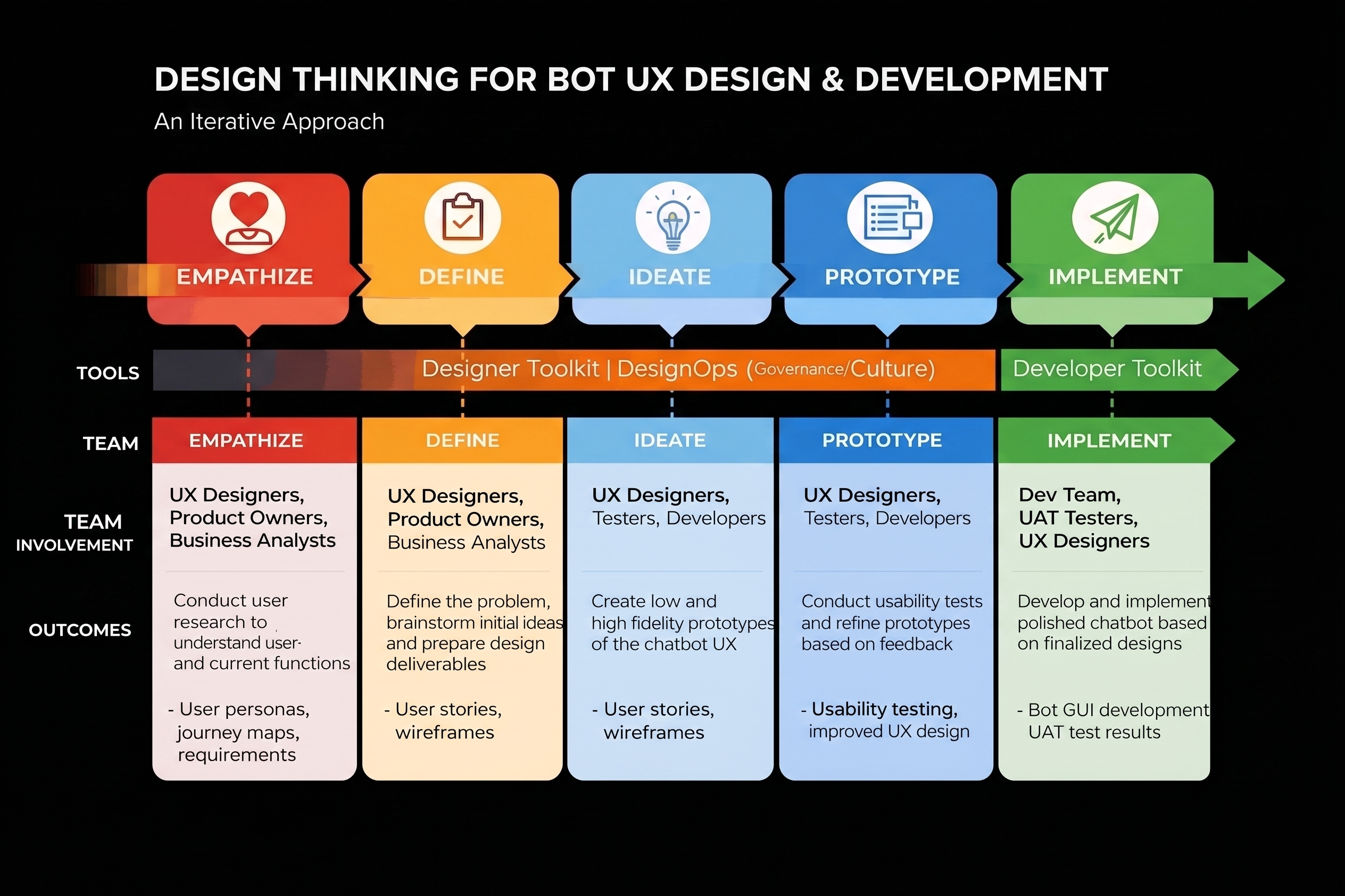
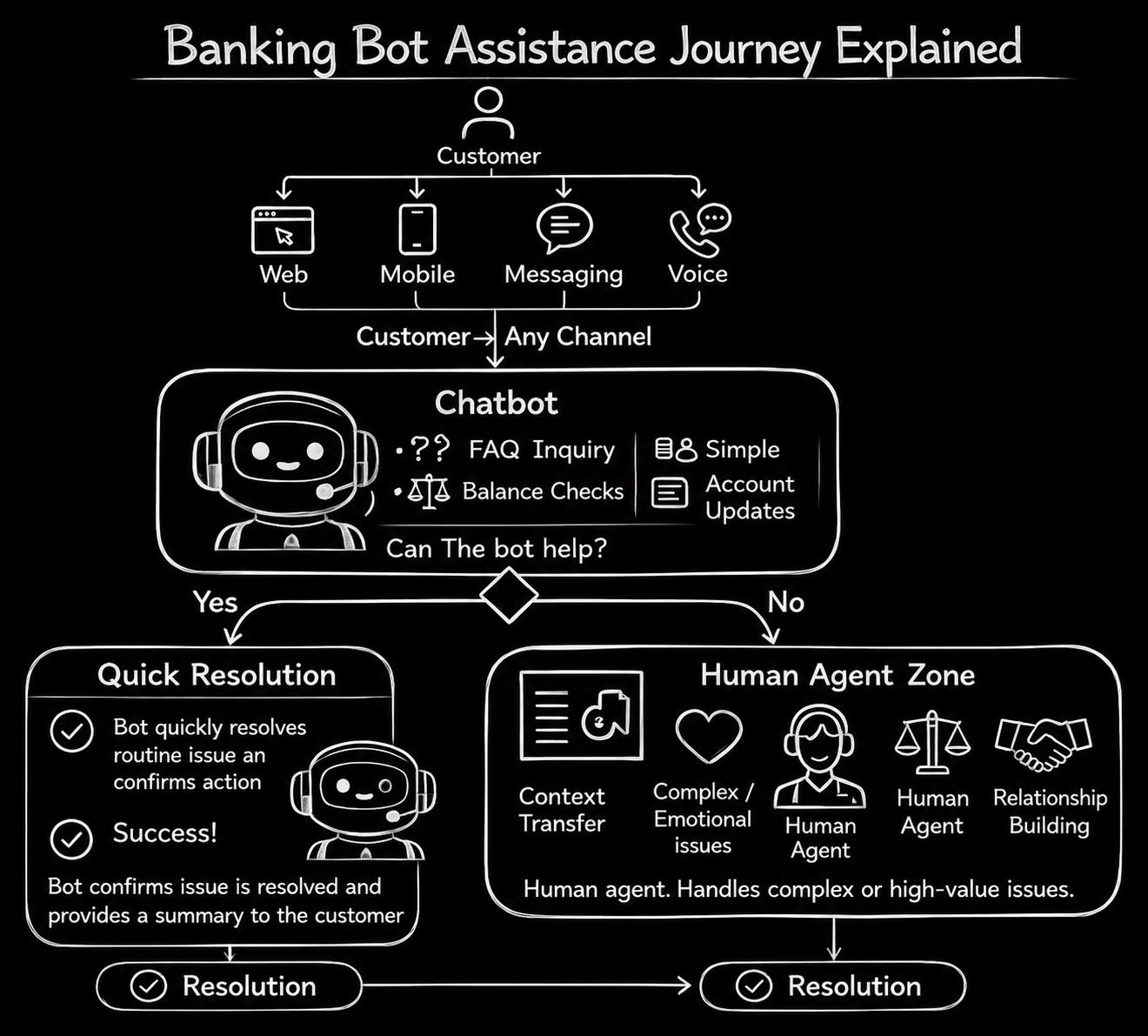
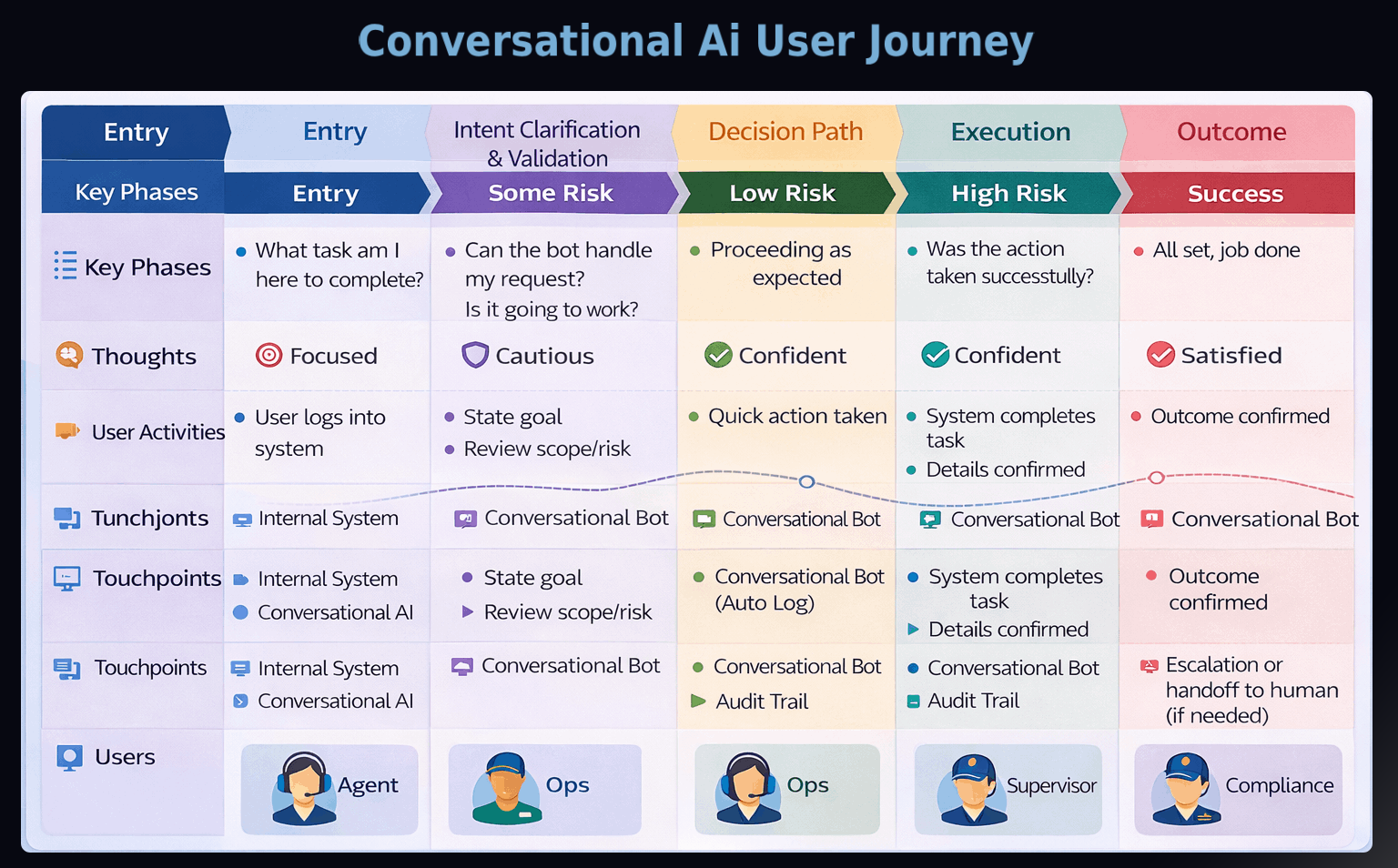
Conversational journeys were mapped turn-by-turn — surfacing where confirmations, fallbacks, and human handoffs needed to live to keep trust intact at every step.

IRA conversational journey — experience strategy and product goals
Experience strategy — conversational journey design
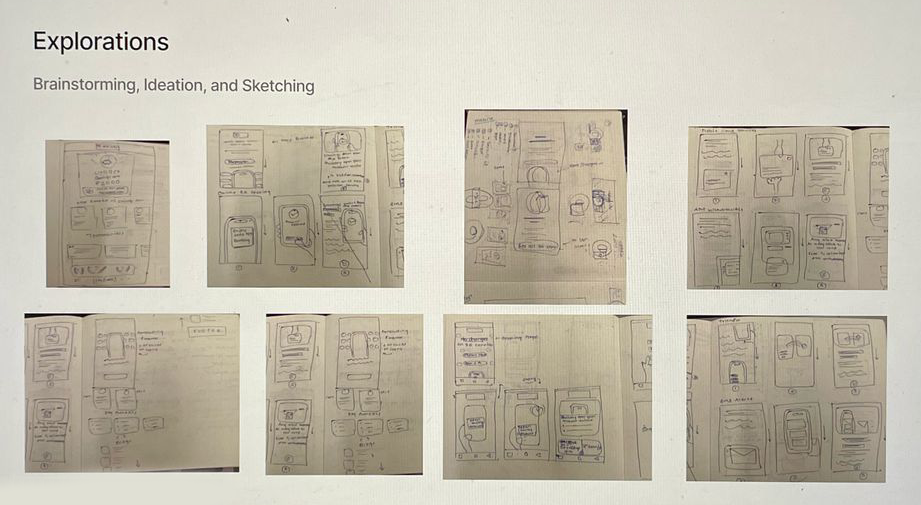
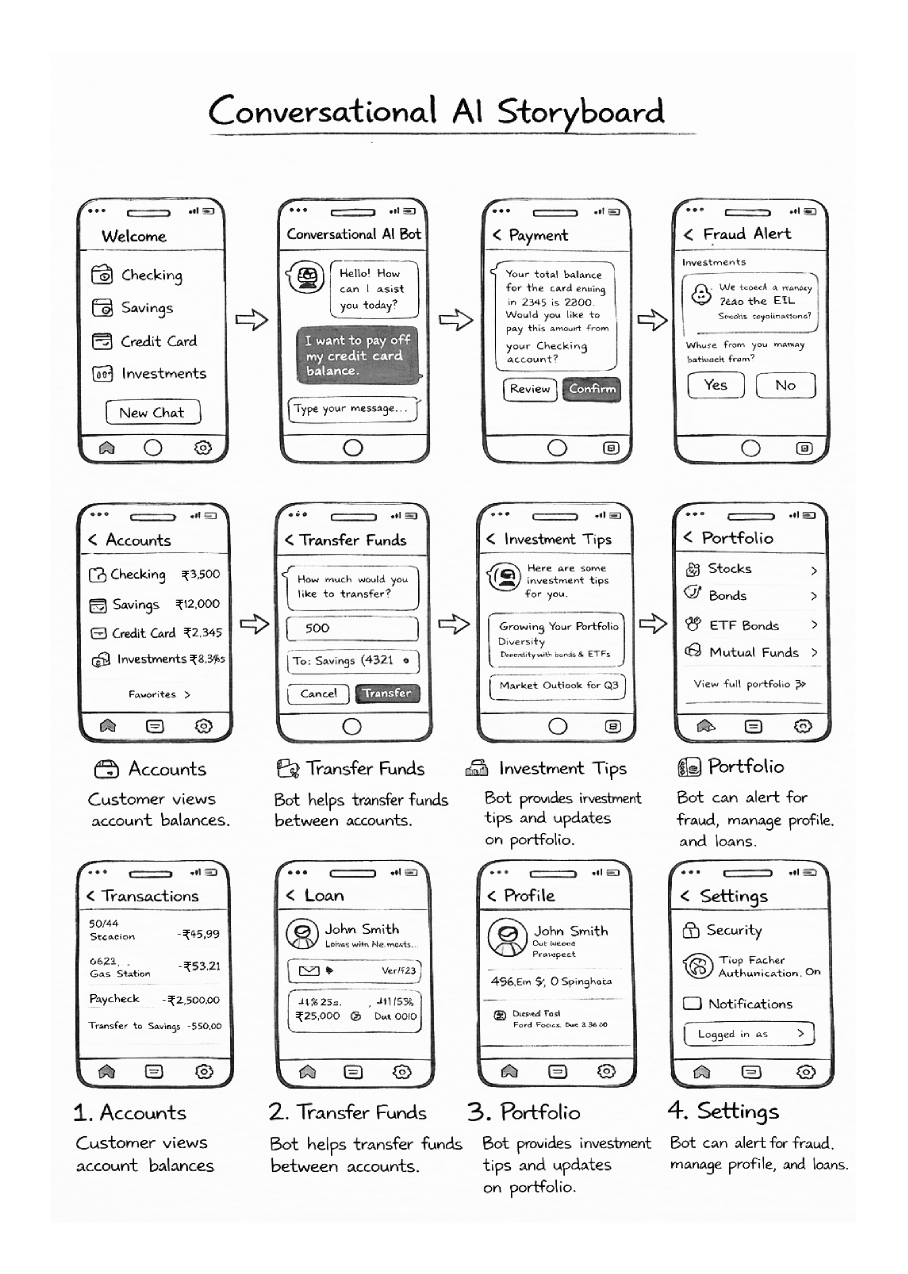
Storyboarding & sketches

Every screen, template, and confirmation message was anchored to a mapped moment. Every sign-off verified that the moment had been designed for, not assumed. The journey map was the canonical reference through every design and vendor review.

Stage 01
Discover
Relevant roles surface fast regardless of audience. Search, filter, and smart sorting reduce time-to-fit.
Stage 02
Evaluate
Growth signals, eligibility, and role fit visible above the fold. Candidates assess before committing to the apply flow.
Stage 03
Apply
Frictionless flow aligned to context and device. Mobile-first, multi-step with clear progress indication.
Stage 04
Post-application
Post-application visibility and communication shape long-term employer perception. Confirmation is strategy, not a detail.
Principle
"Trust in the brand."
Clarity, relevance, and trust drive candidate decisions — at every stage, on every device. The principle anchored every journey decision.
Drag to explore all stages
06 — Storyboarding, app map & wireframing

From storyboards
to a working conversation map.

Storyboards isolated the highest-impact moments in the agent and operations journey, ensuring early alignment across stakeholders and reducing downstream rework during vendor implementation on KORE.ai.

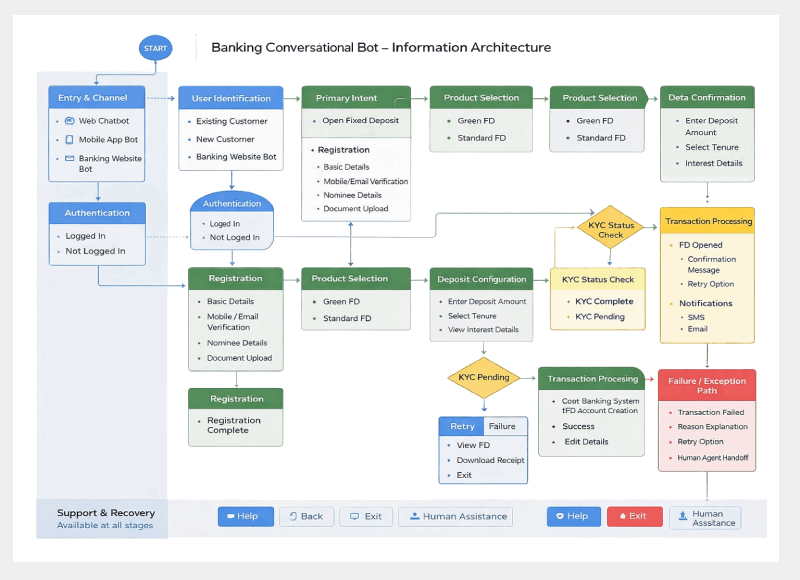
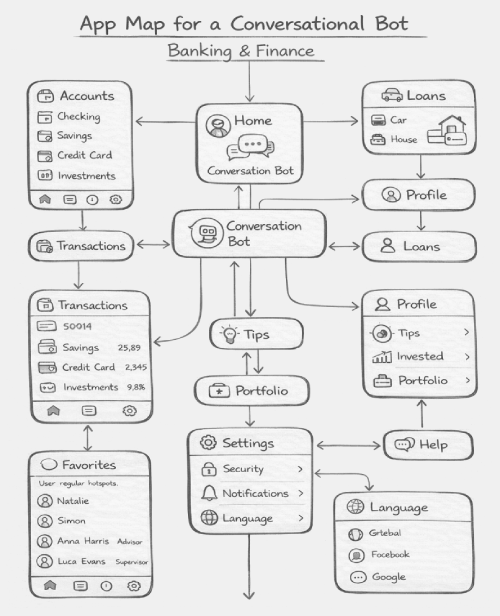
Conversational AI application map — information architecture for the bot
Application map — information architecture for the conversational service
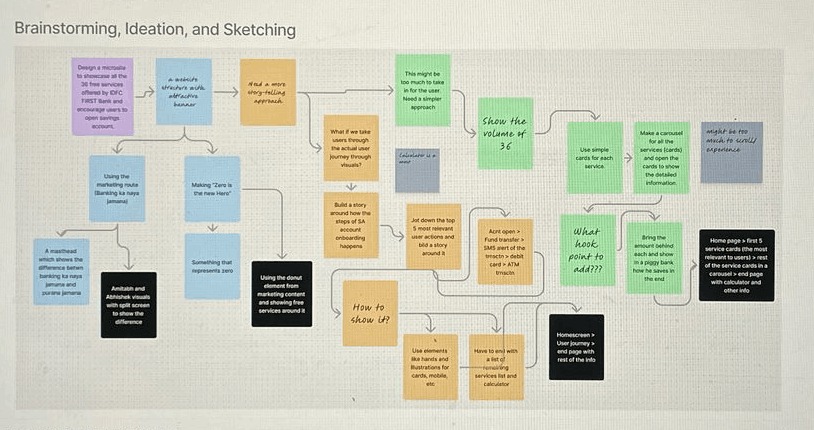
Paper wireframes — early brainstorming and conceptual sketches
Paper wireframes — brainstorming and conceptual sketches
Digital wireframes — structured conversation flows and interaction patterns
Digital wireframes — structured conversation flows

Every wireframe was traceable to a journey moment, and every IA decision was signed off before vendor execution. Storyboards were leveraged to align business, brand, talent acquisition, compliance, and vendor teams on what each moment had to feel like — before any pixels were committed.

Intent capture · Reasoning loop · Action surface — the conversational stack

Homepage Authentication Dashboard Intent Selection Conversation Flow Process Action LOGIN DASHBOARD TRANSACTION(s) CONVERSATION VERIFY
07 — Design system & UI

Conversational patterns.
Token-level governance.

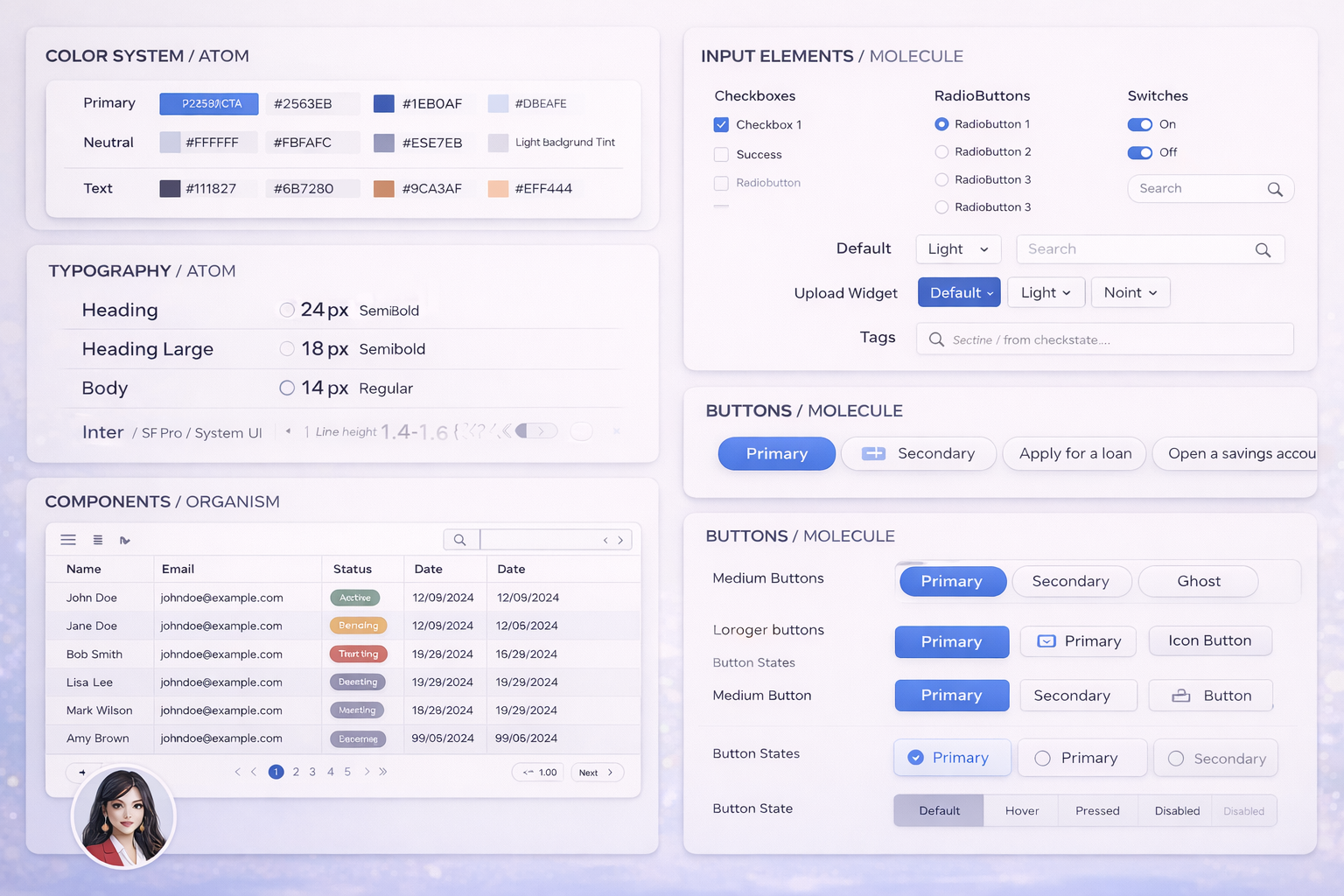
Shared dialog patterns, intent taxonomy, and fallback structures lived inside a reusable conversational UX system — letting domain teams ship independently while delivering coherent, compliant experiences.

Conversation system blueprint
Conversational UX Framework — standardized dialog structure, turn management, confirmations, error recovery, and escalation
Conversational UX Framework — shared enterprise conversation infrastructure


Colour · IRA · Conversational
Conversational AI · violet system
Type · 2 families
Aa Aa
Display / Body pairing
Spacing · 8pt scale
8 / 16 / 24 / 32 / 48
Components · Modular
Reused across hiring journeys & programs
08 — Governance

Govern conversation like infrastructure.

08 — UX governance model

Lightweight governance.
Heavy consistency.

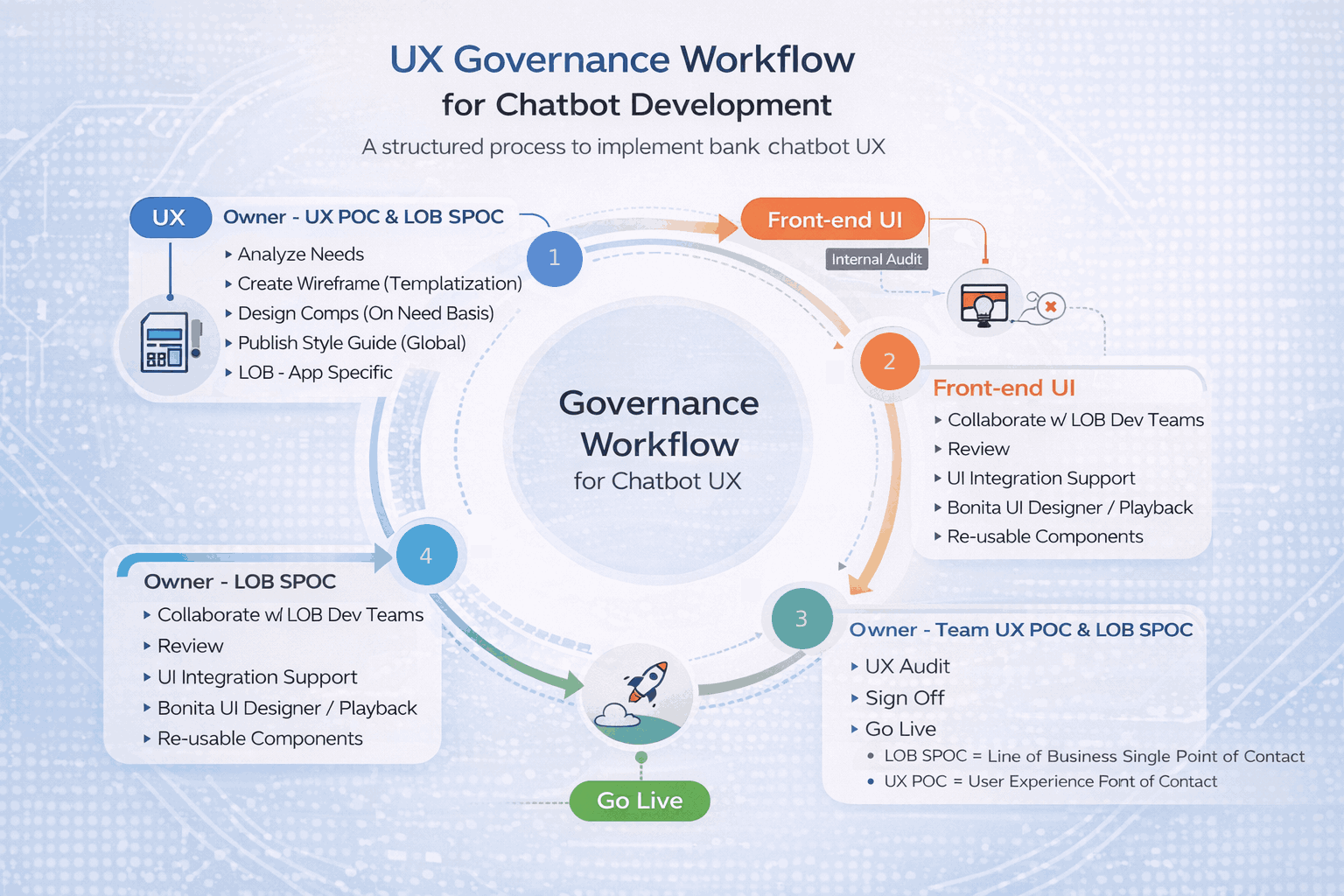
A centralized Conversational UX Governance Model balanced enterprise accountability with team autonomy — focusing on systemic risks like intent clarity, confirmations, and escalation paths rather than surface design.

UX Governance Model — centralized standards with domain autonomy and embedded delivery checkpoints
Conversational UX Governance Model — centralized standards, domain autonomy

Core UX standards and risk controls were centrally maintained, while implementation remained flexible at the domain level. Governance was lightweight and embedded into delivery workflows, focusing on systemic risks — accessibility, regulatory compliance, brand integrity, apply-flow friction — rather than surface-level design. Continuous improvement was driven through analytics and shared learnings.

Pillar 01

Centralized standards

Core UX standards and risk controls maintained centrally — accessibility, brand expression, regulatory compliance. Reviewed and signed off by UX at executive level. The pen on every standard sat with the UX leader, not the vendor.
Pillar 02

Domain autonomy

Implementation flexible at the domain level — vendors and product teams ship within shared guardrails, not on top of them. Faster, safer iteration. The guardrail defines the boundary; what lives inside it belongs to the delivery team.
Pillar 03

Embedded into delivery

Lightweight governance running inside delivery workflows — focused on systemic risks, not surface design. Continuous improvement via analytics and shared learnings enabling the organization to scale while maintaining trust and consistency.
09 — Usability studies

Tested for trust.
Not just task completion.

Usability evaluation focused on intent accuracy, response clarity, perceived trust, and flow efficiency — themes informed conversational design and fallback strategies before scaling to additional domains.

6
Participants matching persona
5
Critical tasks tested
30+
Qualitative insights generated
4
Themes for refinement
Persona needs → design actions
Candidate needQuickly understand if a role is relevant to their skills and experience.
Design actionPersona-based usability testing to validate role clarity; restructured role pages with growth signals above the fold.
Candidate needFind suitable jobs without excessive scrolling or filter friction.
Design actionAnalyzed navigation paths and search behaviour; refined filters and sorting logic to match real candidate criteria.
Candidate needConfidence before starting an application — know what to expect.
Design actionImproved content hierarchy and CTAs; streamlined apply flow to reduce friction at the highest drop-off point.
Candidate needReassurance that submission was received and is being processed.
Design actionValidated confirmation messaging and post-application communication — redesigning as an employer-brand touchpoint, not a utility screen.
Candidate needFast, predictable apply flow on mobile under real conditions.
Design actionAudited and streamlined the apply flow; validated across primary device types matching the persona's usage context.
01

Clarity of roles

Role pages restructured so candidates established relevance within seconds. Headline, signal-bearing tags, and growth indicators surfaced before scroll.

02

Navigation efficiency

Filters and sorting logic refined to align with the criteria candidates actually used — not the criteria the platform exposed by default.

03

Application confidence

Content hierarchy and CTAs improved so candidates entered the apply flow knowing what to expect. Confirmation messaging validated to reassure on submit.

04

Pre-launch readiness

Insights translated into refinements before launch — reducing rework during vendor implementation and surfacing systemic issues that would have appeared only post-release.

10 — Outcomes

Conversational AI scaled
as a trusted enterprise service.

The platform shifted from experimental chatbot work to a governed enterprise capability — designed and approved against defined UX and AI governance guardrails across conversational behavior, model outputs, regulatory requirements, and brand tone.

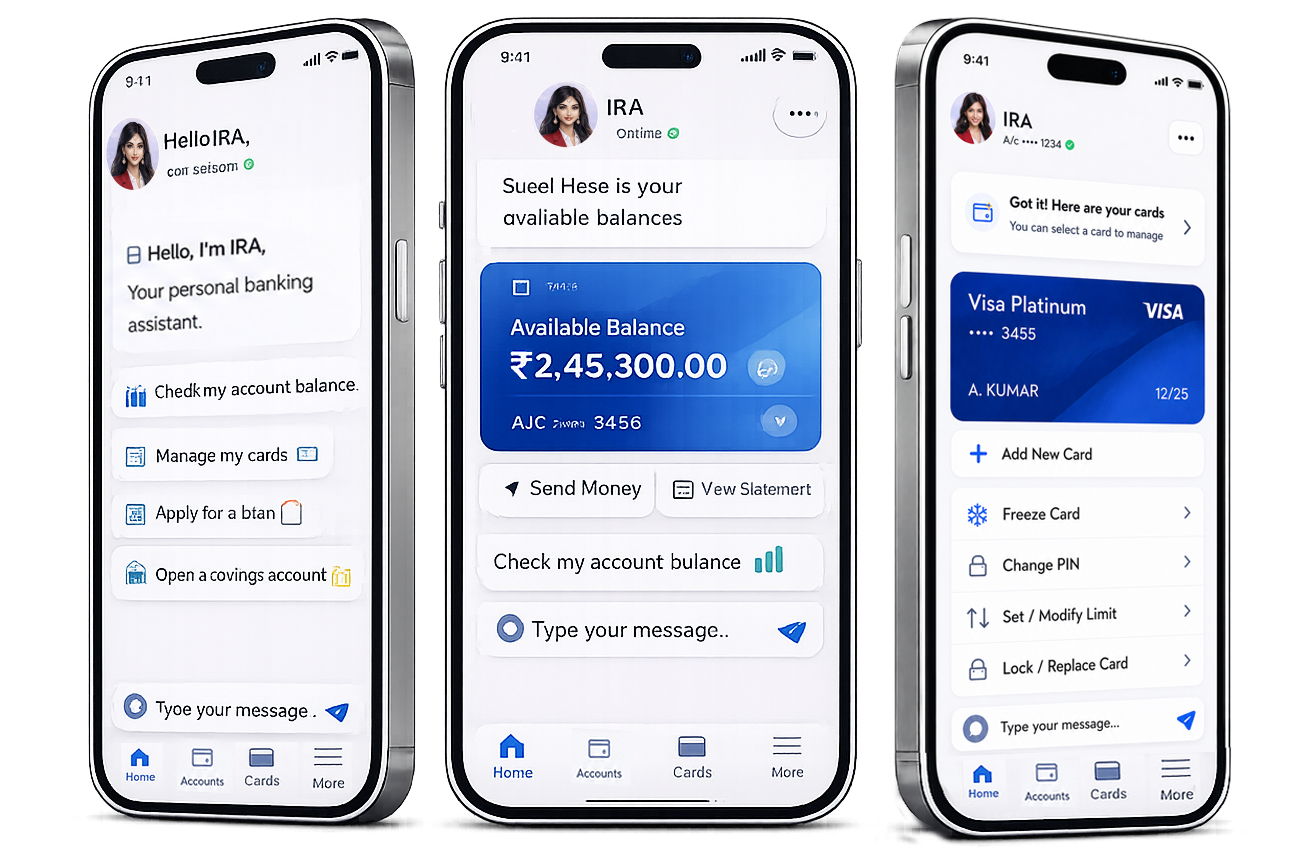
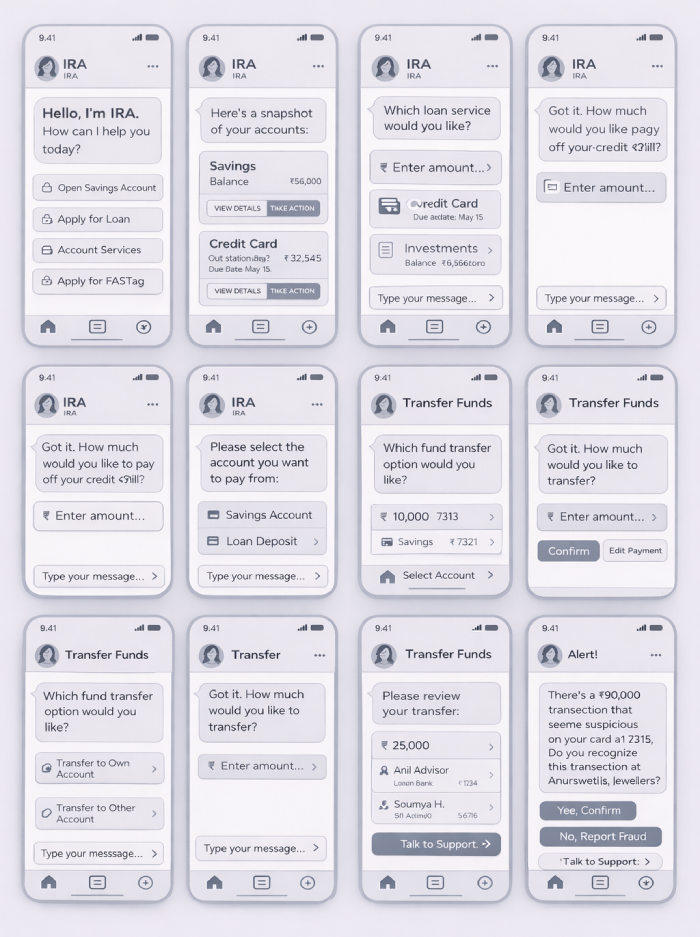
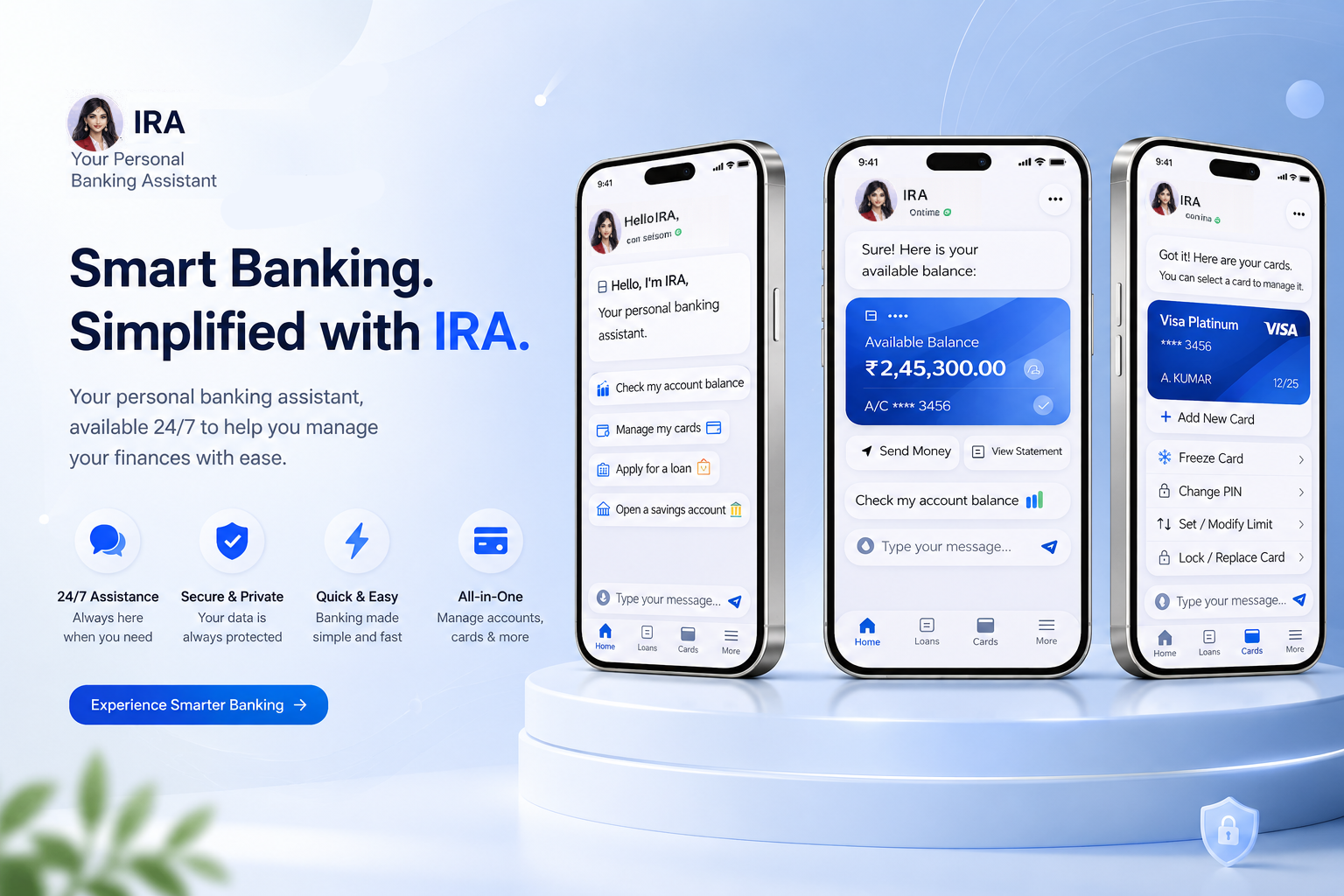
IRA Conversational AI — final demo in production
IRA Conversational AI — final production demo

Siloed bots became a governed conversational service — design moved from isolated flows to shared infrastructure.

Outcome 01
Trust strengthened — explicit confirmations, plain-language explainability, and consistent dialog patterns built reliable mental models.
Outcome 02
Cognitive load reduced — structured step-by-step flows and unified intent taxonomy lowered the burden on users.
Outcome 03
Audit-readiness embedded — transparent responses and traceable conversation logs made every action reviewable.
Outcome 04
Scale achieved without fragmentation — multiple teams ship independently within shared conversational standards.
Outcome 05

A conversational service governed as long-term enterprise infrastructure.

Conversational AI shifted from an experimental feature to shared enterprise infrastructure. Intent taxonomy, dialog patterns, confirmations, fallback, and audit trails sat inside one governance layer that domain teams built within. UX held the pen on the principles that kept conversations coherent, compliant, and trustworthy across the bank.

Conversational UXIntent taxonomyExplainable AIAudit-readyProgressive disclosureHuman handoffRisk-aware designKORE.ai governance
11 — Reflection

What I'd carry forward.

Designing trustworthy conversational AI in regulated environments is a governance discipline as much as a design one. These are the lessons I'd carry forward.

The hardest part wasn't the bot.

It was shifting the organization from shipping flows to operating a conversational service.
01

Conversation is infrastructure, not a feature.

Treating conversational AI as shared enterprise infrastructure — with shared intent taxonomy, dialog patterns, and governance — produced consistency that isolated bots could never deliver. The framework was the product.

02

Trust beats speed in high-stakes workflows.

Users prioritized control, clarity, and explainability over raw efficiency. Deliberate confirmations and step-by-step flows on critical actions strengthened adoption rather than slowing it.

03

Recovery and handoff are first-class experiences.

Fallbacks and human handoffs designed as first-class moments — not exceptions — reinforced trust precisely when failure would have eroded it. The exception path was the trust path.

04

Govern lightweight; govern early.

Embedding standards into delivery workflows kept governance fast. Centralized accountability with domain autonomy let teams ship independently while keeping the service coherent across the bank.