VP, UX & Product Design · 2024 · Banking · Education Platform

Finance literacy as governed learning.

An enterprise-grade financial literacy platform for IDFC FIRST Academy — built to educate diverse audiences at scale under stringent regulatory and compliance constraints. As VP of UX, I defined the experience vision and governance model, ensuring every decision reinforced trust, clarity, and learning effectiveness across products, teams, and vendors.

🎓
100%
Compliant by design
📚
Modular
Reusable learning paths
🤝
Cross-team
Compliance · Content · Product
📈
Scalable
From basics to advanced
Personas
Trusted by Leading Brands
IDFC FIRST BankIDFC FIRST AcademyRBI-alignedComplianceLegalContent OpsProduct
Scroll
01 — Context

Educate diverse audiences without publishing in silos.

01 — Project overview

From content portal
to learning ecosystem.

Financial literacy initiatives in large banks rarely fail on content — they fail on systemic patterns. The mandate was to design a learning system, not another content site.

01 — Context

Content-first thinking

Information was being published without learning journeys, progression, or measurable outcomes. Users consumed content but did not build understanding.
02 — Constraints

Fragmented ownership

Responsibility was split across marketing, compliance, product, and external vendors — producing inconsistent experiences, duplication, and slow evolution.
03 — Opportunity

Compliance, reframed

Regulatory requirements were being implemented defensively, increasing cognitive load and weakening trust. The opportunity was to embed compliance as a design pattern, not a disclaimer.
Business objectives

What the organization needed to achieve

  • Establish IDFC FIRST Academy as a trusted financial literacy brand
  • Educate diverse audiences at scale across knowledge levels
  • Operate within strict regulatory and compliance constraints
  • Reduce fragmentation across teams, vendors, and content programs
  • Build a system that could evolve sustainably over time
UX & design goals

What the experience needed to do

  • Reduce cognitive load through clear, step-by-step learning flows
  • Use progressive disclosure to reveal complexity only when relevant
  • Embed trust through plain language, confirmations, and explainability
  • Establish modular UX patterns reusable across modules and programs
  • Make governance a design property, not a downstream review
02 — Research & discovery

Confidence varies.
Expectations don't.

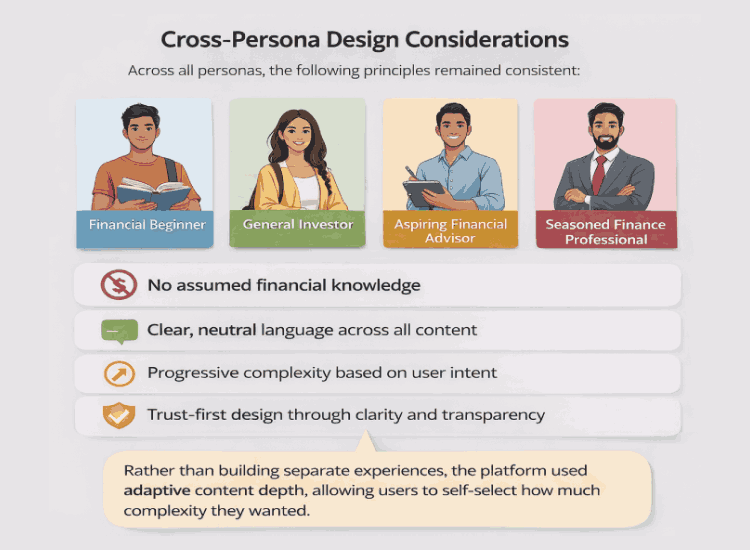
Research revealed that while user confidence levels differed widely, expectations around clarity, trust, and control were consistent across all personas — plain, neutral language significantly improved comprehension and reduced perceived risk.

User research synthesis

Users had uneven financial knowledge and disengaged when assumptions were made or language became overly technical. They did not resist complexity; they resisted forced complexity — progressive disclosure driven by user intent measurably increased engagement and confidence.

Rather than building fragmented persona-based experiences, the platform adopted adaptive content depth — allowing users to choose how much detail they needed. This approach improved scalability, reduced cognitive load, and reinforced trust across all user groups.

"I want to start with the basics — but I don't want to feel talked down to."

First-time learner · Mobile primary

"Just tell me what the rules are. Don't bury them in jargon."

Mid-career professional · Comparing products

"If I have to read three paragraphs to know what this means, I close the tab."

Senior user · Accessibility-sensitive
User personas

Three confidence profiles.

F
First-time learner
Mobile-first · Starting from basics
Approaches financial topics cautiously. Needs neutral language, clear next steps, and no assumed prior knowledge before committing time.
Plain languageStep-by-stepReassurance
M
Mid-career professional
Comparison-led · Active learner
Already familiar with core concepts. Wants depth, comparison, and a credible source — not surface-level explainers.
Depth on demandCredibleEfficient
S
Senior user
Accessibility-sensitive · Trust-led
Reads carefully and rereads. High-contrast typography, generous spacing, and clear confirmations build confidence before action.
High contrastGenerous spacingConfirmation-led
03 — Core problem

Financial education without governance is content debt at scale.

01

Content was published without designed learning journeys — users consumed but did not build understanding.

02

Ownership fragmented across marketing, compliance, product, and vendors — producing inconsistent experiences.

03

Regulatory disclosure crowded out comprehension — compliance read as risk-aversion, not service.

04

No reusable patterns — every new topic required redesigning the journey, slowing evolution and increasing rework.

04 — My role & execution

Experience strategy.
Governance by design.

I led the UX vision and execution across the platform — translating regulatory, educational, and operational requirements into a coherent, user-centric experience.

The platform was reframed as a learning ecosystem, not a content portal — with intent-based entry points, structured paths, standardized content templates, and unified interaction patterns. UX standards governed clarity, accessibility, and progression. Regulatory and policy requirements were translated into reusable design patterns, embedding compliance into the experience rather than treating it as a downstream check.

Responsibility 01

Define experience strategy

  • Authored the experience vision and principles for the academy
  • Established intent-based entry points and structured learning paths
  • Defined adaptive content depth as the core engagement model
  • Signed-off principles used as the contract for vendor and content teams
Responsibility 02

Govern execution

  • Embedded UX standards across compliance, content, product, and vendors
  • Reviewed and approved every milestone before release
  • Translated regulatory requirements into reusable design patterns
  • Held final accountability for experience quality
Responsibility 03

Establish design system & templates

  • Built modular UX patterns aligned to the bank's design system
  • Standardized content templates for readability and comprehension
  • Created governance review checkpoints for new content
  • Reduced rework through pattern reuse
Responsibility 04

Enable cross-functional teams

  • Facilitated co-creation workshops with product, compliance, legal, and content
  • Aligned teams on what must be shown vs progressively disclosed
  • Enabled teams to ship independently within shared guardrails
  • UX coaching paired with quarterly governance reviews
05 — User journey map

Discover. Learn.
Build confidence. Return.

Users discover topics through intent-based entry points, progress through structured paths with visible milestones, and return as confidence compounds — measured engagement, not page views.

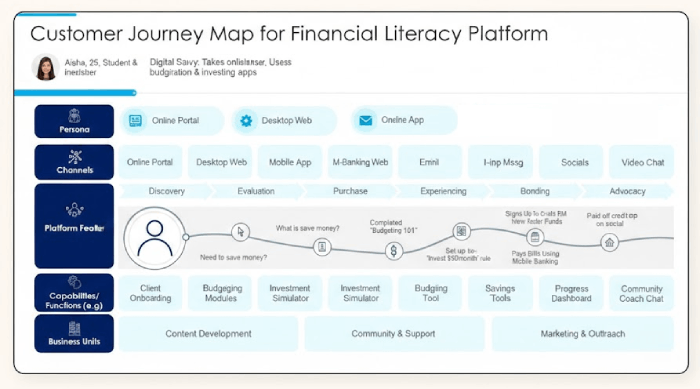
Learner journey map
Learner journey map

Every screen, template, and confirmation message was anchored to a mapped moment. Every sign-off verified that the moment had been designed for, not assumed. The journey map was the canonical reference through every design and vendor review.

Stage 01
Discover
Relevant roles surface fast regardless of audience. Search, filter, and smart sorting reduce time-to-fit.
Stage 02
Evaluate
Growth signals, eligibility, and role fit visible above the fold. Candidates assess before committing to the apply flow.
Stage 03
Apply
Frictionless flow aligned to context and device. Mobile-first, multi-step with clear progress indication.
Stage 04
Post-application
Post-application visibility and communication shape long-term employer perception. Confirmation is strategy, not a detail.
Principle
"Trust in the brand."
Clarity, relevance, and trust drive candidate decisions — at every stage, on every device. The principle anchored every journey decision.
Drag to explore all stages
06 — Storyboarding, app map & wireframing

From audits
to a learning architecture.

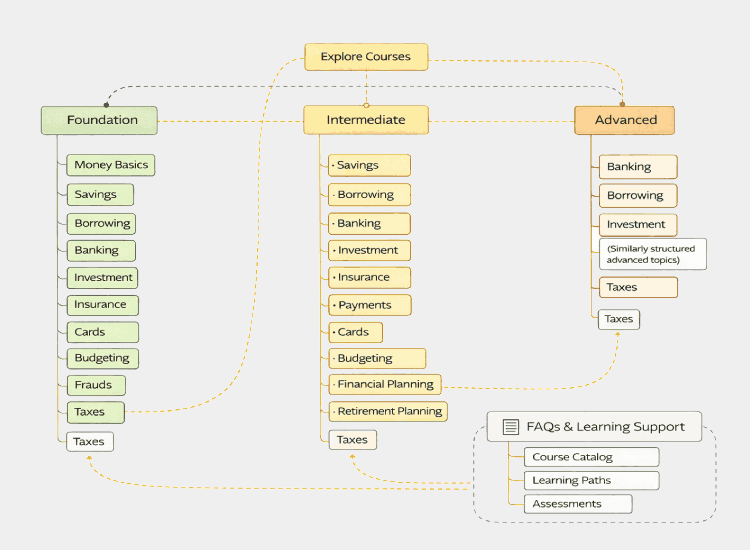
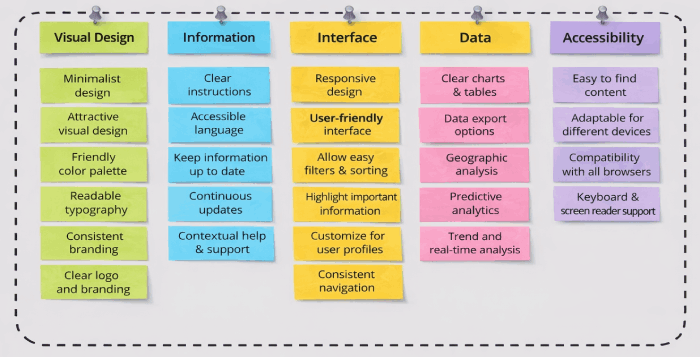
Existing content, journeys, and analytics were audited to identify drop-off and comprehension gaps. The new architecture organized topics into intent-based entry points with progressive depth.

Information architecture

Every wireframe was traceable to a journey moment, and every IA decision was signed off before vendor execution. Storyboards were leveraged to align business, brand, talent acquisition, compliance, and vendor teams on what each moment had to feel like — before any pixels were committed.

Discovery · Learning path · Progress checkpoint — the three load-bearing surfaces of the academy

Homepage Explore Courses Learning Path Learn Module(s) Quiz & Assessment Certification DISCOVER LEARN PERSONALIZE BUILD KNOWLEDGE GROW
07 — Design system & UI

Patterns over pages.
System over screens.

A modular design system aligned to the bank's tokens — standardized content templates, accessible typography, and reusable components that scaled across modules and programs without redesign.

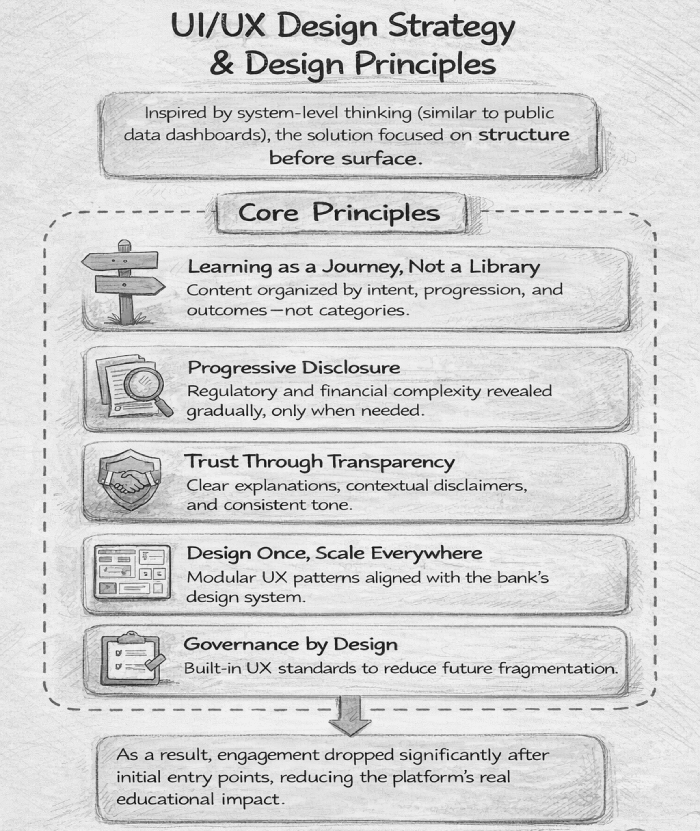
Strategy framework
Strategy framework
Colour · IDFC FIRST Academy
Aligned to IDFC FIRST brand neutrals
Type · 2 families
Aa Aa
Display / Body pairing
Spacing · 8pt scale
8 / 16 / 24 / 32 / 48
Components · Modular
Reused across hiring journeys & programs
08 — Governance

Embed compliance into patterns, not paragraphs.

08 — UX governance model

Compliance as
a design pattern.

A centralized governance model maintained UX, accessibility, and regulatory standards while letting domain teams build independently within shared guardrails.

Core UX standards and risk controls were centrally maintained, while implementation remained flexible at the domain level. Governance was lightweight and embedded into delivery workflows, focusing on systemic risks — accessibility, regulatory compliance, brand integrity, apply-flow friction — rather than surface-level design. Continuous improvement was driven through analytics and shared learnings.

Pillar 01

Centralized standards

Core UX standards and risk controls maintained centrally — accessibility, brand expression, regulatory compliance. Reviewed and signed off by UX at executive level. The pen on every standard sat with the UX leader, not the vendor.
Pillar 02

Domain autonomy

Implementation flexible at the domain level — vendors and product teams ship within shared guardrails, not on top of them. Faster, safer iteration. The guardrail defines the boundary; what lives inside it belongs to the delivery team.
Pillar 03

Embedded into delivery

Lightweight governance running inside delivery workflows — focused on systemic risks, not surface design. Continuous improvement via analytics and shared learnings enabling the organization to scale while maintaining trust and consistency.
09 — Usability studies

Comprehension first.
Engagement follows.

Iterative validation with internal users and stakeholders surfaced where instructional clarity needed work — content hierarchy and explanatory patterns were refined before rollout, not after.

6
Participants matching persona
5
Critical tasks tested
30+
Qualitative insights generated
4
Themes for refinement
Persona needs → design actions
Candidate needQuickly understand if a role is relevant to their skills and experience.
Design actionPersona-based usability testing to validate role clarity; restructured role pages with growth signals above the fold.
Candidate needFind suitable jobs without excessive scrolling or filter friction.
Design actionAnalyzed navigation paths and search behaviour; refined filters and sorting logic to match real candidate criteria.
Candidate needConfidence before starting an application — know what to expect.
Design actionImproved content hierarchy and CTAs; streamlined apply flow to reduce friction at the highest drop-off point.
Candidate needReassurance that submission was received and is being processed.
Design actionValidated confirmation messaging and post-application communication — redesigning as an employer-brand touchpoint, not a utility screen.
Candidate needFast, predictable apply flow on mobile under real conditions.
Design actionAudited and streamlined the apply flow; validated across primary device types matching the persona's usage context.
01

Clarity of roles

Role pages restructured so candidates established relevance within seconds. Headline, signal-bearing tags, and growth indicators surfaced before scroll.

02

Navigation efficiency

Filters and sorting logic refined to align with the criteria candidates actually used — not the criteria the platform exposed by default.

03

Application confidence

Content hierarchy and CTAs improved so candidates entered the apply flow knowing what to expect. Confirmation messaging validated to reassure on submit.

04

Pre-launch readiness

Insights translated into refinements before launch — reducing rework during vendor implementation and surfacing systemic issues that would have appeared only post-release.

10 — Outcomes

A learning system
that scales without fragmenting.

The academy moved from publishing content to operating a learning system — credible, inclusive, and scalable, with UX as the strategic control point.

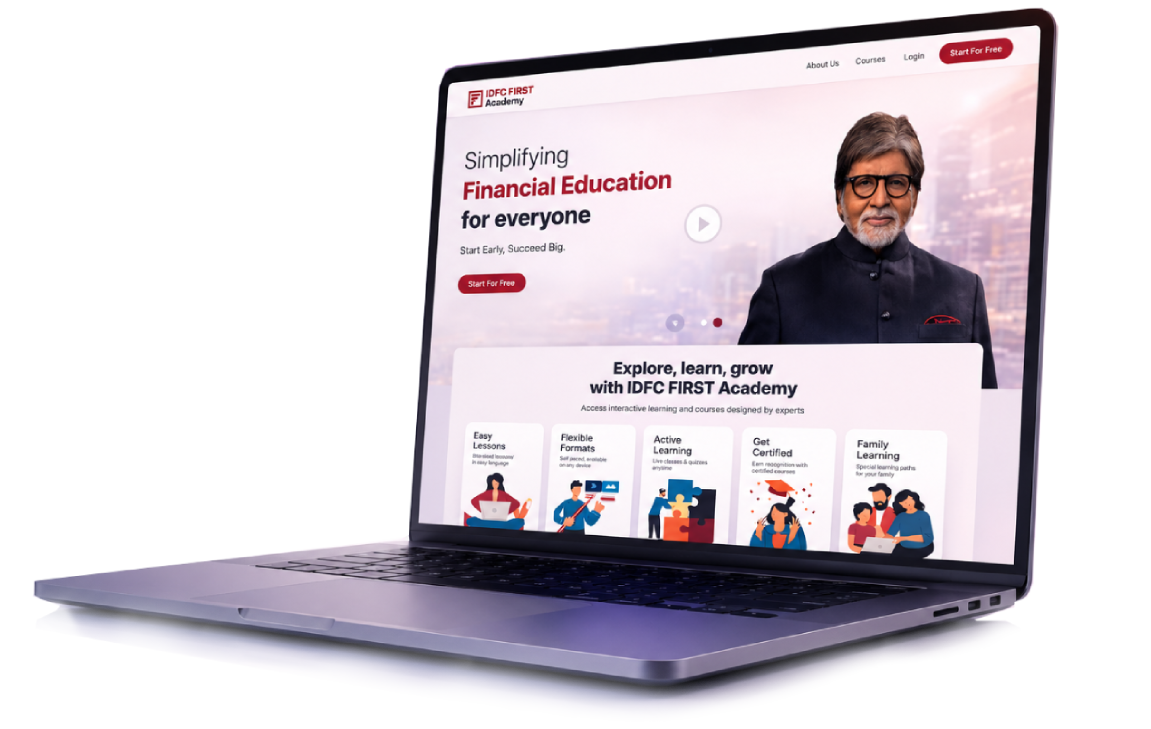
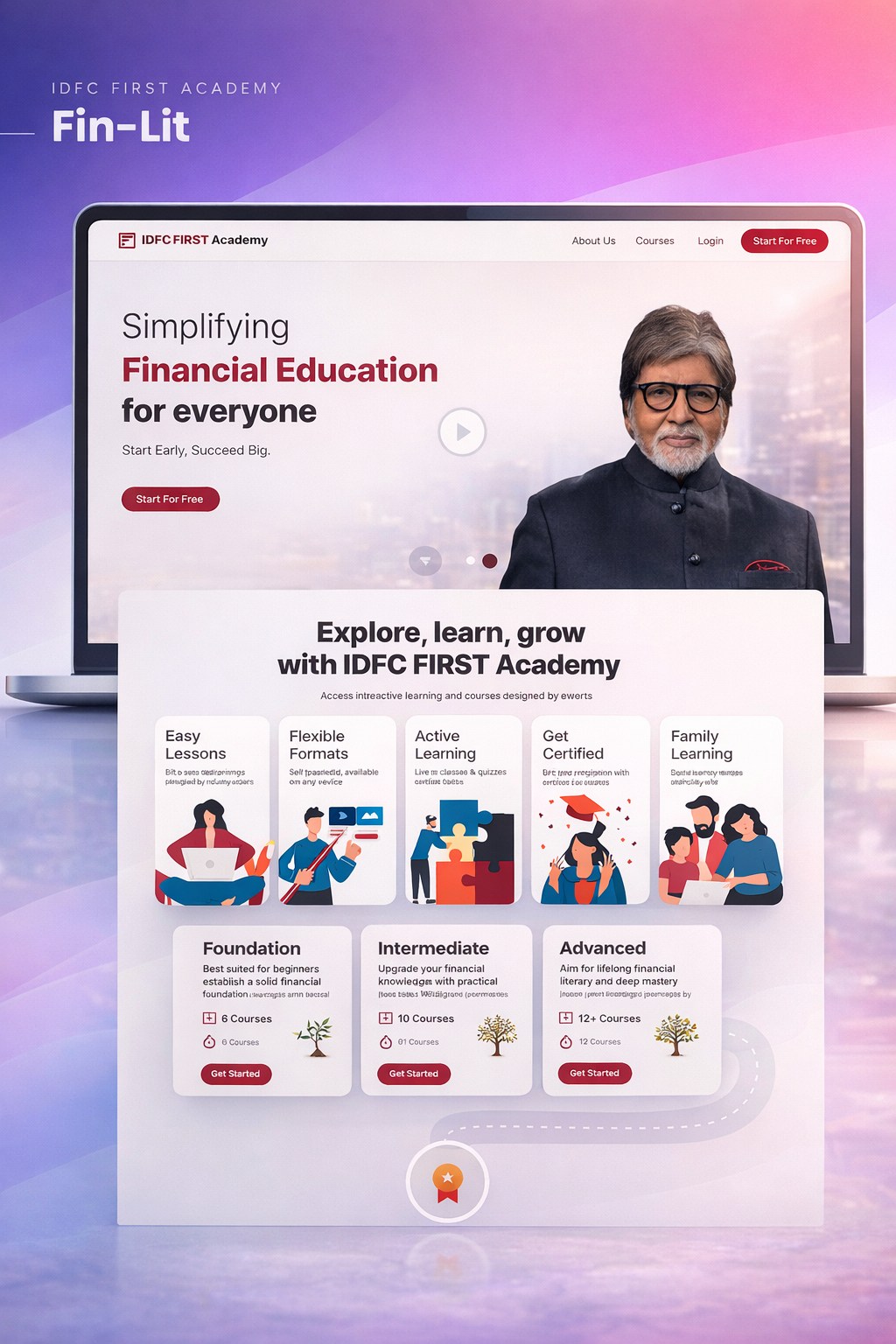
Final product — live

A regulated bank's financial literacy program became a governed learning ecosystem — design moved from publishing content to operating a system.

Outcome 01
Compliance embedded in patterns — regulatory requirements built into templates rather than added as downstream review.
Outcome 02
Engagement deepened — adaptive content depth replaced one-size explainers, reducing drop-off after entry points.
Outcome 03
Velocity unlocked — modular design system let teams ship independently within shared guardrails.
Outcome 04
Trust compounded — plain language, accessible typography, and clear progression turned the academy into a credible source.
Outcome 05

A single, governed learning system across topics and programs.

The academy shifted from a content portal to a long-term product system. Compliance, accessibility, brand, and learning effectiveness shared one governance layer. New topics and programs could be absorbed without renegotiating the foundations. UX held the pen on the principles that kept the experience coherent at scale.

Learning ecosystemAdaptive depthPlain languageModular UXCompliance by patternWCAG-alignedCross-team governanceSustainable evolution
11 — Reflection

What I'd carry forward.

Designing for financial literacy is a governance shift before it is a content exercise. These are the lessons I'd carry into any regulated education platform.

Design challenges & learnings
The hardest part wasn't the content.

It was shifting the organization from publishing to operating a learning system.
01

Content fails because of governance, not gaps.

Financial literacy programs do not fail for lack of material — they fail because ownership is fragmented and progression is unstructured. Establishing UX as the governing layer turned isolated content into a coherent learning system.

02

Compliance is a design pattern, not a disclaimer.

Embedding regulatory requirements into reusable templates and components moved compliance from defensive paragraphs to a quiet, consistent property of the experience — strengthening trust rather than draining it.

03

Confidence varies; expectations don't.

Users at every knowledge level expect clarity, trust, and control. Adaptive content depth — letting users choose how much they need — outperformed persona-specific experiences and was easier to govern.

04

Operate the system; don't ship the page.

Treating the academy as a long-term product system rather than a launch milestone meant patterns, governance, and review checkpoints kept the experience consistent as topics, contributors, and programs evolved.

Final deliverable

See the live academy experience.

View source case study