Usability Engineering · Wells Fargo · FXOL / iFXOL · MphasiS

Trading UX as recognition, not recall.

Mission-critical UX redesign for Wells Fargo's FXOL / iFXOL — Foreign Exchange Online — enabling institutional users to perform spot and forward FX transactions, manage currency exposure, and access multi-currency settlement and reporting. The mandate was to reduce cognitive load, standardize interaction patterns, and establish a scalable UX foundation for a regulated enterprise trading platform.

Faster
Task completion
🧠
Recognition
Over recall
🧩
Standardized
Cross-module patterns
📐
Scalable
Long-term UX foundation
Personas
Trusted by Leading Brands
Wells FargoMphasiSFXOLiFXOLInstitutional usersEnterprise
Scroll
01 — Context

In high-frequency trading, recognition beats recall every time.

01 — Project overview

Mission-critical workflows
made recognizable.

FXOL / iFXOL supports institutional users performing spot and forward FX transactions, currency exposure management, and multi-currency settlement. The redesign focused on efficiency, consistency, and a scalable foundation aligned with enterprise standards.

01 — Context

Highly complex FX workflows

Frequent FX users carried high cognitive load through dense screens and inconsistent interaction patterns across modules.
02 — Constraints

Requirements evolving in parallel

Business and functional requirements were evolving alongside the UI redesign — UX work happened in parallel with definition, not after.
03 — Opportunity

Scalable, long-term UX foundation

The opportunity was a reusable UX foundation aligned with enterprise standards — one that could absorb future enhancements without repeated redesign.
Business objectives

What the organization needed to achieve

  • Reduce user memory load through recognition-based UI patterns
  • Standardize screen elements across the application
  • Improve task efficiency for high-frequency users
  • Create a scalable UI foundation for future enhancements
  • Increase flexibility without compromising performance
UX & design goals

What the experience needed to do

  • Simplify screen layouts and consistent labeling and grouping
  • Standardize UI components and interaction behaviors across modules
  • Design task-driven workflows for critical FX operations
  • Establish reusable layout structures and components
  • Support expert users without overwhelming new users
02 — Research & discovery

Expert users.
Time-sensitive decisions.

Research focused on how high-frequency FX users actually worked — under real time pressure and across multiple modules — surfacing where memory load was carrying the burden of inconsistent patterns.

Workflow analysis and task decomposition revealed where inconsistency between modules forced users to relearn behaviors. Smart defaults, inline validation, consistent labeling, and logical grouping emerged as the highest-leverage interventions for high-frequency trading screens.

Information architecture rationalization paired with interaction modeling and iterative stakeholder validation established the foundation for a long-term, vendor-proof UX system.

"If two screens behave differently for the same action, I lose seconds I can't get back."

FX trader · High-frequency

"I want defaults that match how I work — not a blank form every time."

Institutional user · Daily operations

"Show me the calculation, not just the result. I need to trust it before I commit."

Settlement user · Audit-facing
User personas

Expert users in time-pressure.

T
FX trader
High-frequency · Time-sensitive
Executes spot and forward transactions under tight windows. Needs recognition over recall, smart defaults, and minimal friction on high-value actions.
RecognitionSmart defaultsMinimal friction
I
Institutional user
Daily operations · Multi-module
Moves across rate views, exposure dashboards, and settlement screens repeatedly. Needs predictable patterns and consistent navigation across the platform.
PredictableConsistentCross-module
S
Settlement user
Audit-facing · Validation-led
Needs traceability, clear calculations, and recognizable controls. Confidence comes from transparency, not speed.
TraceableTransparentRecognizable
03 — Core problem

Inconsistent modules tax high-frequency users every minute.

01

Highly complex workflows created high cognitive load for frequent FX users.

02

Inconsistent screens and interaction patterns across modules slowed task completion.

03

Business and functional requirements were evolving in parallel with UI redesign.

04

Need for scalable, long-term UX solutions aligned with enterprise standards.

04 — My role & execution

Recognition over recall.
Standardization at module level.

I owned the application of recognition-based UX principles across FXOL / iFXOL workflows — simplifying layouts, introducing consistent labeling and grouping, and reducing cognitive load for high-frequency users.

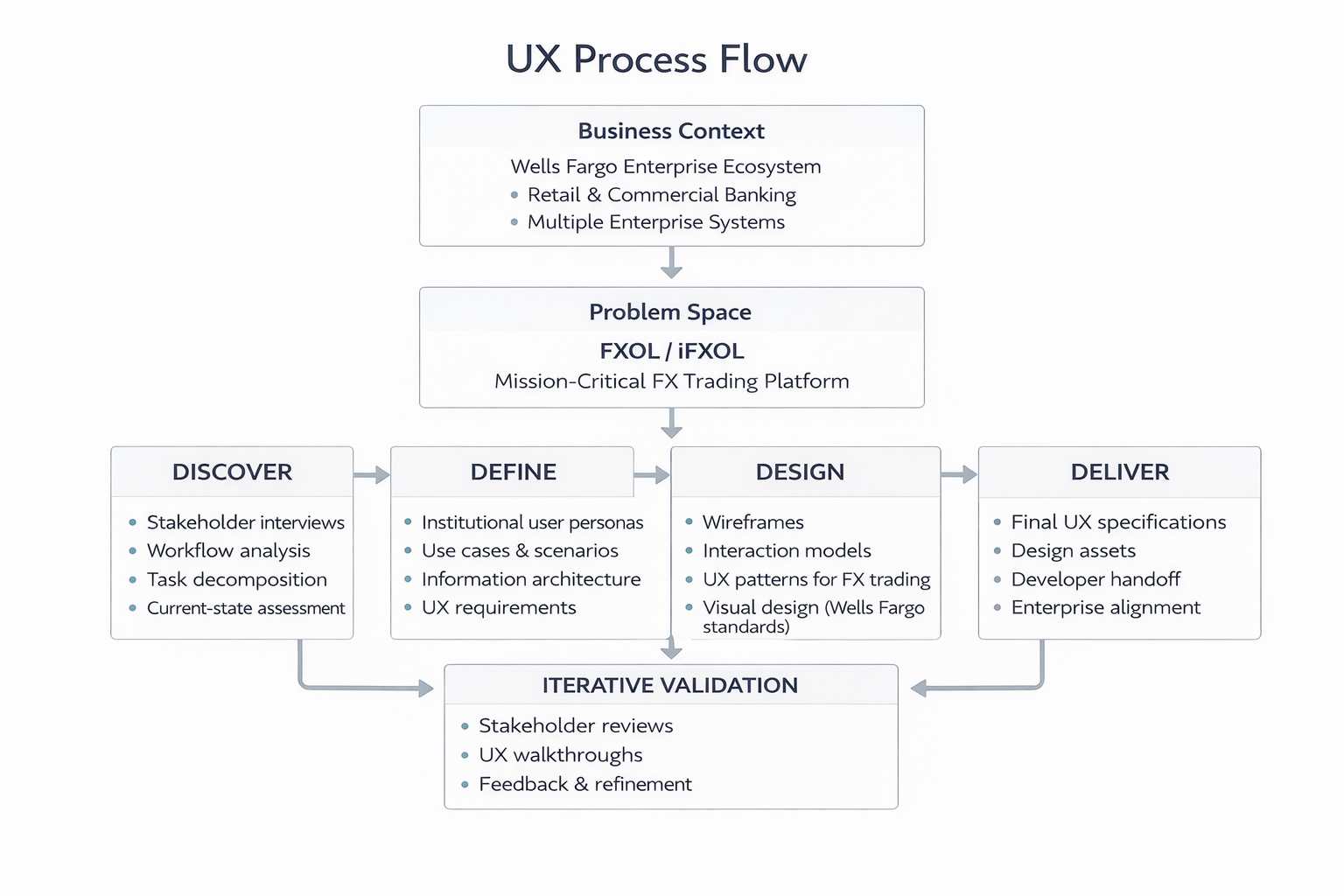
The engagement followed a structured 4D (Discover–Define–Design–Deliver) methodology. UX progressed in parallel with business and functional definition — workflow analysis and task decomposition, IA rationalization, wireframing and interaction modeling, visual design aligned to Wells Fargo brand standards, and iterative stakeholder validation.

Responsibility 01

Reduce user memory load

  • Applied recognition-based UX principles across workflows
  • Simplified screen layouts and grouping
  • Introduced consistent labeling across modules
  • Reduced cognitive load for high-frequency users
Responsibility 02

Standardize screen elements

  • Implemented consistent UI components and interaction behaviors
  • Addressed long-standing inconsistencies between modules
  • Created predictable experiences across the platform
  • Improved learnability and reduced user errors
Responsibility 03

Improve task efficiency

  • Designed and refined task-driven workflows for critical FX operations
  • Minimized unnecessary steps and optimized screen flow
  • Prioritized high-value actions
  • Enabled expert users to complete transactions faster
Responsibility 04

Establish scalable UX foundation

  • Created reusable layout structures and UI components
  • Provided a long-term UX foundation for future enhancements
  • Standardized form and workflow patterns
  • Smart defaults, inline validation, logical grouping
05 — User journey map

Open. Recognize.
Execute. Settle.

FX journeys were decomposed task-by-task — surfacing where consistency, smart defaults, and recognition-based UI could remove friction from high-frequency operations.

Trader workflow
Trader workflow

Every screen, template, and confirmation message was anchored to a mapped moment. Every sign-off verified that the moment had been designed for, not assumed. The journey map was the canonical reference through every design and vendor review.

Stage 01
Discover
Relevant roles surface fast regardless of audience. Search, filter, and smart sorting reduce time-to-fit.
Stage 02
Evaluate
Growth signals, eligibility, and role fit visible above the fold. Candidates assess before committing to the apply flow.
Stage 03
Apply
Frictionless flow aligned to context and device. Mobile-first, multi-step with clear progress indication.
Stage 04
Post-application
Post-application visibility and communication shape long-term employer perception. Confirmation is strategy, not a detail.
Principle
"Trust in the brand."
Clarity, relevance, and trust drive candidate decisions — at every stage, on every device. The principle anchored every journey decision.
Drag to explore all stages
06 — Storyboarding, app map & wireframing

From wireframes
to a responsive trading UI.

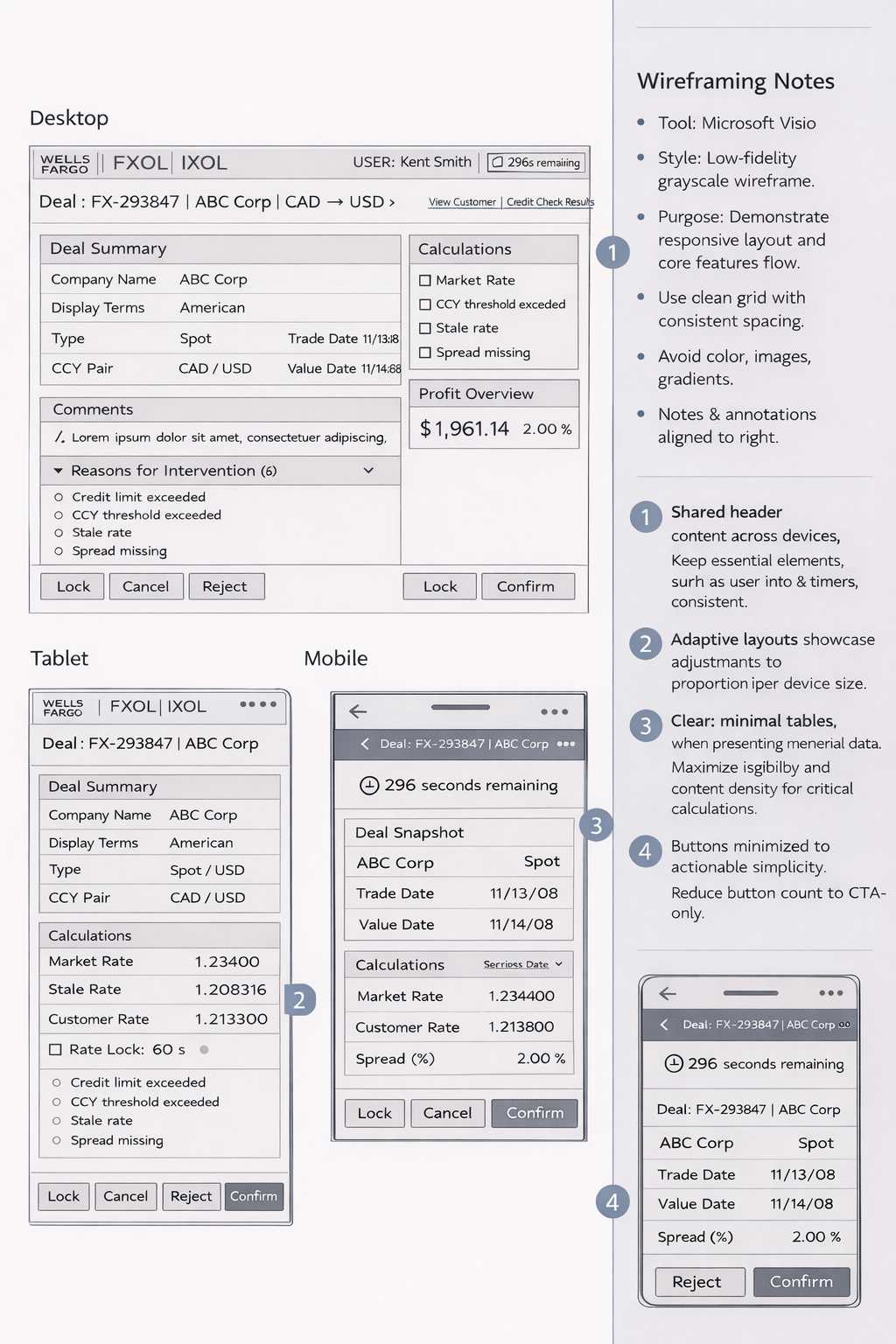
Low-fidelity, grayscale wireframes for iFXOL articulated complex FX trading workflows across desktop, tablet, and mobile — focusing on information hierarchy, decision-critical data, and responsive behavior over visual styling.

Wireframes
Wireframes

Every wireframe was traceable to a journey moment, and every IA decision was signed off before vendor execution. Storyboards were leveraged to align business, brand, talent acquisition, compliance, and vendor teams on what each moment had to feel like — before any pixels were committed.

Pricing · Execution · Ledger — institutional FX in three surfaces

Homepage Job Listing Role Detail Apply Flow Confirmation Status Track SEARCH & FILTER GROWTH SIGNALS MOBILE-FIRST TRUST-BUILDING VISIBILITY
07 — Design system & UI

Reusable patterns.
Recognition by default.

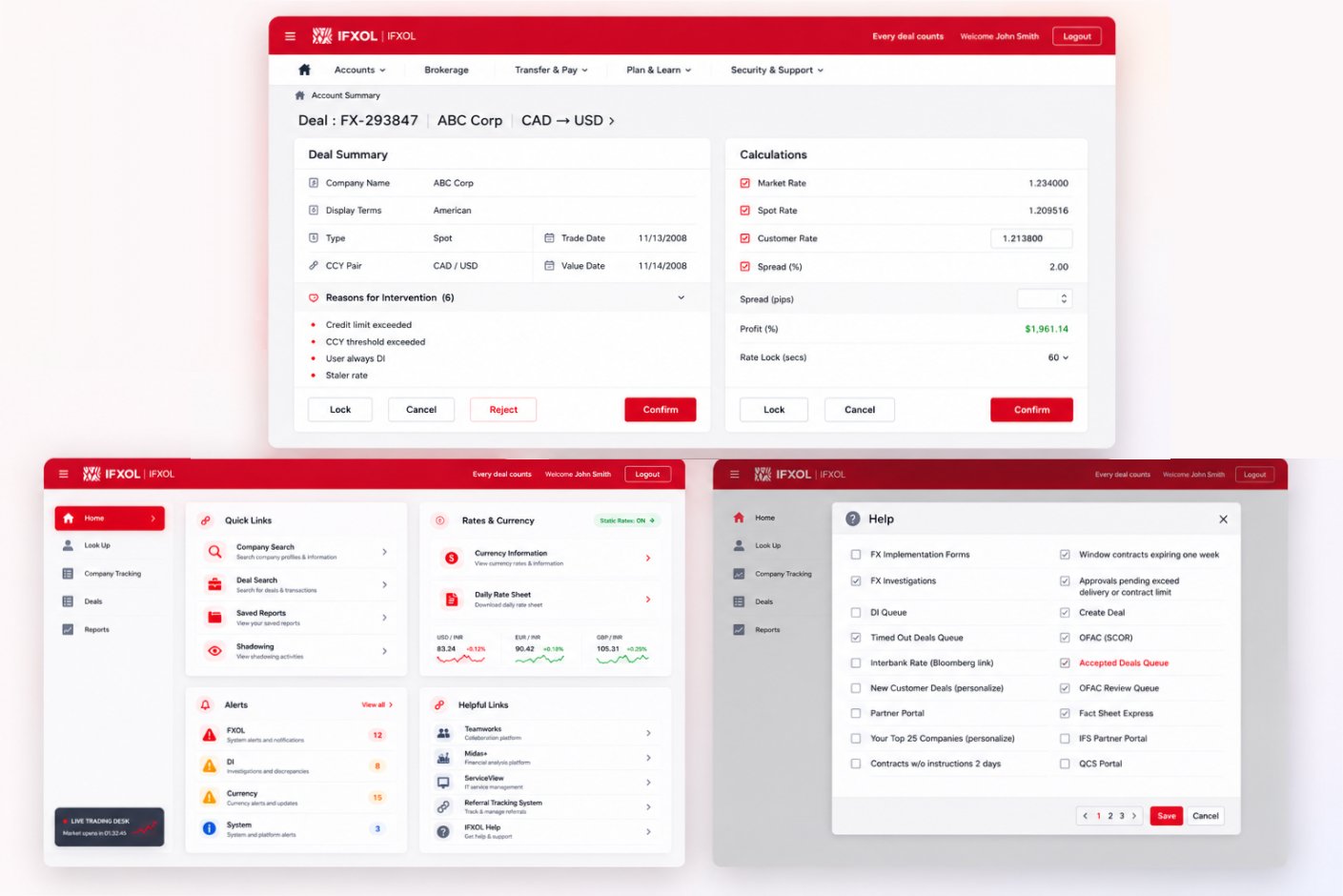
Reusable layouts, consistent labeling, smart defaults, and inline validation — encoded into a UI foundation that could extend across the FXOL ecosystem without repeated redesign.

IXOL design system
IXOL design system
Colour · Wells Fargo · FX
Wells Fargo · red & cream
Type · 2 families
Aa Aa
Display / Body pairing
Spacing · 8pt scale
8 / 16 / 24 / 32 / 48
Components · Modular
Reused across hiring journeys & programs
Aligned to WellsFargo brand neutrals
08 — Governance

Standardize the patterns. Free the users.

08 — UX governance model

Enterprise standards.
Module-level consistency.

UX standards governed module-level consistency — turning a fragmented platform into a predictable system where high-frequency users could trust every screen.

Core UX standards and risk controls were centrally maintained, while implementation remained flexible at the domain level. Governance was lightweight and embedded into delivery workflows, focusing on systemic risks — accessibility, regulatory compliance, brand integrity, apply-flow friction — rather than surface-level design. Continuous improvement was driven through analytics and shared learnings.

Pillar 01

Centralized standards

Core UX standards and risk controls maintained centrally — accessibility, brand expression, regulatory compliance. Reviewed and signed off by UX at executive level. The pen on every standard sat with the UX leader, not the vendor.
Pillar 02

Domain autonomy

Implementation flexible at the domain level — vendors and product teams ship within shared guardrails, not on top of them. Faster, safer iteration. The guardrail defines the boundary; what lives inside it belongs to the delivery team.
Pillar 03

Embedded into delivery

Lightweight governance running inside delivery workflows — focused on systemic risks, not surface design. Continuous improvement via analytics and shared learnings enabling the organization to scale while maintaining trust and consistency.
09 — Usability studies

Validated with stakeholders.
Iterated continuously.

Iterative validation with Wells Fargo stakeholders refined patterns under real workflow constraints — ensuring usability improvements held up under time-sensitive, regulated trading conditions.

6
Participants matching persona
5
Critical tasks tested
30+
Qualitative insights generated
4
Themes for refinement
Persona needs → design actions
Candidate needQuickly understand if a role is relevant to their skills and experience.
Design actionPersona-based usability testing to validate role clarity; restructured role pages with growth signals above the fold.
Candidate needFind suitable jobs without excessive scrolling or filter friction.
Design actionAnalyzed navigation paths and search behaviour; refined filters and sorting logic to match real candidate criteria.
Candidate needConfidence before starting an application — know what to expect.
Design actionImproved content hierarchy and CTAs; streamlined apply flow to reduce friction at the highest drop-off point.
Candidate needReassurance that submission was received and is being processed.
Design actionValidated confirmation messaging and post-application communication — redesigning as an employer-brand touchpoint, not a utility screen.
Candidate needFast, predictable apply flow on mobile under real conditions.
Design actionAudited and streamlined the apply flow; validated across primary device types matching the persona's usage context.
01

Clarity of roles

Role pages restructured so candidates established relevance within seconds. Headline, signal-bearing tags, and growth indicators surfaced before scroll.

02

Navigation efficiency

Filters and sorting logic refined to align with the criteria candidates actually used — not the criteria the platform exposed by default.

03

Application confidence

Content hierarchy and CTAs improved so candidates entered the apply flow knowing what to expect. Confirmation messaging validated to reassure on submit.

04

Pre-launch readiness

Insights translated into refinements before launch — reducing rework during vendor implementation and surfacing systemic issues that would have appeared only post-release.

10 — Outcomes

Modernized trading UX
on a scalable foundation.

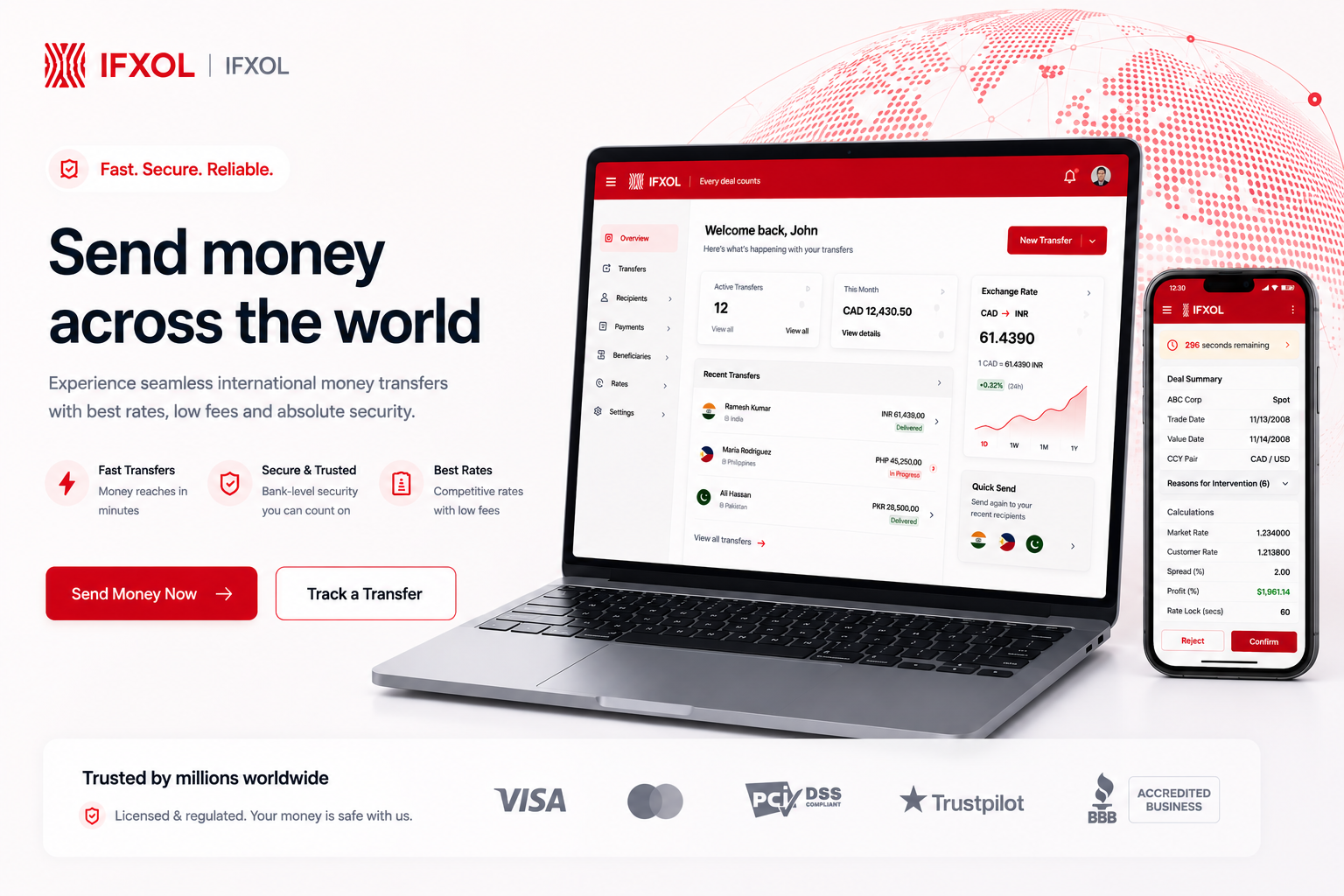
The redesigned FXOL / iFXOL platform improved usability, reduced cognitive load, and established a consistent interaction framework across modules — strengthening MphasiS' positioning as a strategic UX partner.

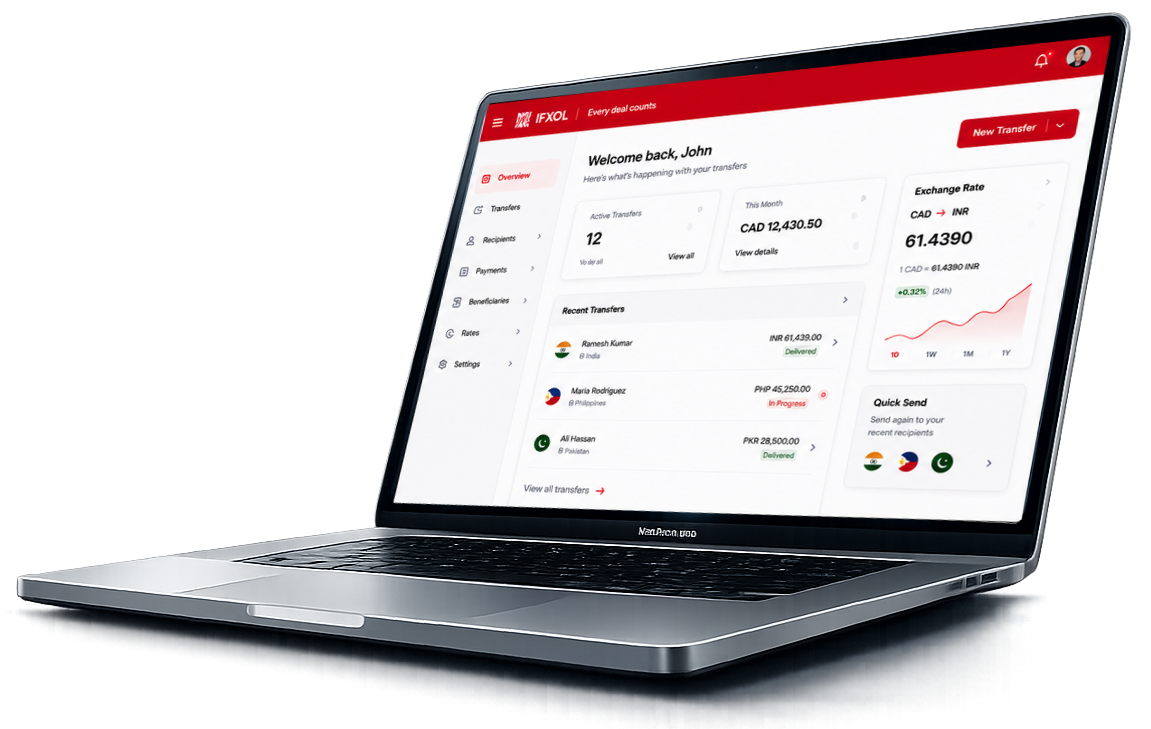
Live trading desk
Live trading desk

An inconsistent enterprise trading platform became a recognition-based system — design moved from module-by-module fixes to standardized patterns.

Outcome 01
Improved task completion efficiency for frequent FX users through recognition-based UI.
Outcome 02
Reduced learning curve through standardized interaction patterns across modules.
Outcome 03
Reusable UX foundation established for future enhancements without repeated redesign.
Outcome 04
Strengthened MphasiS positioning as a strategic UX partner for enterprise trading platforms.
Outcome 05

A scalable UX foundation for enterprise FX trading.

Reusable layout structures, consistent labeling, smart defaults, and inline validation gave FXOL / iFXOL a UX foundation that could absorb future enhancements without renegotiating the fundamentals. Recognition replaced recall, standardization replaced inconsistency, and high-frequency users got back the seconds they had been losing to fragmented patterns.

Recognition over recallStandardizationSmart defaultsInline validationTask efficiencyResponsive trading UIEnterprise UXReusable foundation
11 — Reflection

What I'd carry forward.

Modernizing enterprise trading UX while requirements evolved in parallel taught durable lessons about pattern discipline and recognition-based design.

The hardest part wasn't the visuals.

It was standardizing patterns while requirements kept evolving around them.
01

Recognition is the highest-leverage move in expert UX.

High-frequency users compensate for inconsistency with memory — and memory has a ceiling. Recognition-based patterns paid back every minute they cost to design.

02

Standardize at the module level, not the screen.

Module-level pattern consistency unlocked compounding gains. Fixing individual screens treated symptoms; fixing patterns treated the cause.

03

Build a foundation that absorbs change.

Because requirements evolved in parallel with the redesign, the UX foundation had to be vendor-proof and extensible by default. Reusable layouts and components carried the redesign past the engagement.

04

Design for expert users without locking out new ones.

Smart defaults, inline validation, and logical grouping accelerated experts while staying learnable for newcomers — the platform served both without compromise.

Final deliverable

See the source case study.

View source case study